

Prana Breath is the universal vital energy that is literally the thing of life. For all of us who practice yoga, the major challenge for us is to harness this energy so that it can fuel our mental, physical, and spiritual development. In order to do this, we have to look deeply into the mysteries that surround our mind as well as the subtle body. Fortunately, the Tantra’s early practitioners have voyaged into this particular inner landscape, mapping the different ways the energy in our body circulates within us. Among their most crucial discoveries were the Nadis, which are the vast network of energy channels that make us an integrated, vital, and conscious whole.
The Nadi is a Sanskrit word that comes from the root “nad”, which means the “flow”, “vibration”, or “motion”. The word itself depicts the basic fundamental nature of the Nadi, to flow like water, which finds the path of least resistance and also nourishes everything that comes in its path. The Nadis are essentially the energetic irrigation system, which, in essence, keep us alive.
In the energy body or the Pranamayakosha, there are 72,000 Nadis. These Nadis are channels or pathways of prana breath in the system. These 72,000 Nadis don’t have any type of physical manifestation. In a sense, if you cut the body of a human being, you won’t find any of it. But when you become more aware of the body, you will certainly notice that the energy in the body isn’t moving at random. It is moving in underlying and established pathways. There are 72,000 various ways in which the prana breath or energy moves in the body.
Nadis are the energy channels through which the divine energy of the body, life, as well as consciousness or Prana, streams. Within our human body, there is a perfect and subtle inherent network of these Nadis that distribute the life force throughout our entire body. On the physical level, the Nadis correspond to the nervous system of the body, but the influence of these Nadis extends beyond this and to the astral as well as spiritual planes of our existence. If all these Nadis are functioning and working properly, then we will be healthy and feel happy, in general. But nearly each one of us is suffering from some sort of psychic or physical problems, which means that many of the Nadis aren’t functioning properly, and there is a requirement to balance them.
Prana breath is the conscious energy that essentially means that the Nadis of our body also transmit consciousness. Through Nadis, one can easily see as well as hear things from a distance of greater proportion and move in other consciousness levels. There are many reports from people who were considered to be clinically dead, and then they came back to life. Many of them described how they travelled through the tunnel, which has a light radiating at the end of it. This tunnel is called the Nadi through which the prana or life escapes from the body.
All of us can have such tunnel experiences in our dreams as well as on astral journeys. With these, we aren’t actually outside our body but in a sort of altered state of consciousness. These Nadis make it quite possible for us to take this mental journey of discovery through our entire universe. With the assistance of these Nadis, our consciousness can go from our body to any place we would like to go without the movement of our body at all.
Three Nadis
They are the Ida, Pingala, and Sushumna.
Ida(left or moon)
It is the left channel. It is white, cold, and feminine,e which represents the moon, and it is associated with the river Ganges or Ganga. It originates in Muladhara, and Ida ends up in the left nostril of our body.
Pingala (right or sun)
It is the right channel. It is red as well as masculine, along with hot, as it represents the sun, and it is associated with the river Yamuna. It originates in Muladhara. It ends up in the right nostril of our body.
Sushumna (center )
It is the central channel that is associated with the Saraswati River. Within this Shushumna Nadi, there are three more essential subtle channels which are Vajra, Chitrni, as well as Bhrama Nadi through which the Kundalini moves upwards in the body running up from just below the Muladhara chakra toSahasrara chakra, then all up to the crown of the head.
How the Three Nadis Work Together
When it comes to the physical level, the Pingala is the counterpart in our Parasympathetic Nervous system, while the Ida is the counterpart in the Sympathetic Nervous system. The Sushumna is in the Central Nervous System of the body.
The moon here symbolizes the minds which have its changeable feelings, while the sun represents the intellect of the mind. Just like our emotions as well as thoughts, which keep on changing constantly, the moon is also changing its form constantly. The intellect in the mind, however, is a stable and constant principle like the sun. Only when the harmony as well as balance prevail between the sun and the moon system, are we actually healthy as well as capable of developing both mentally and spiritually.
We are able to harmonize and activate the Nadis through our breath. When we breathe through the left nostril of our nose in Pranayama, we activate our Ida Nadi. The Ida Nadi cools as well as quietens and refreshes the body as well as the mind, like the moon’s silvery light. The Pingala Nadi, however, which is influenced by breathing through the right nostril, has a warming as well as activating influence, just in the same way as sunshine warms our earth, along with stimulating the growth of vegetation.
Ida and Pingala begin in our brain at approximately the Pituitary gland level. Ida affects the brain’s right side, while the Pingala influences the left side of the brain. To maintain the balance, both Nadis run in just like a snake-like path from one side of our body to the other. At the points where these Nadis cross, they meet with the central Nadi, which is Sushumna. At those places where the radiance, as well as the power of the sun and the moon, meet, together with the Sushumna’s strengthening effect, the powerful energy centers in the body, which are called Chakras, are formed.
The first crossing of these Nadis at the tops of our spinal column forms the Vishuddhi Chakra or the Throat Chakra, and the last crossing at the base of our spinal column forms the Muladhara Chakra or the Root Centre. Here, the Ida Nadi flows from the left side of our body and the Pingala Nadi on our right side, and it is precisely in this actual position here that our dormant consciousness of our body lies hidden.
At different places along our spinal column, these Nadis form a particular type of knot, which is called a Granthi, and each of these constitutes an essential point in the spiritual development of our mind and the body. When these knots or Granthis are “untied”, the energy which is located within these Granths gets activated and the Siddhis or the hidden powers are given to us as a type of healing powers which allows us to see the past as well as the future, along with seeing the auras as well as the other supernatural abilities.
When it comes to the other three Nadis, the Ida, Pingala, and Sushumna, they are Ganga, Yamuna, and Sarasvati, respectively. These are the names of three of the holiest rivers in India. The Ganga and the Yamuna flow at the surface of the earth, but the Sarasvati flows underground. It rises at the surface one in every twelve years only. This event happens in conjunction with a specific planetary constellation, which is also known as theKumbha Mela. This great and holiest spiritual festival of India happens at the confluence of these three rivers, which is called the Sangam, and it is attended by millions of people from all over who come here to attain liberation and freedom from their Karmas as well as the cycle of rebirth by taking a bath in the sacred waters. But for the Yogi, these three main Nadis are his divine rivers as well as the eyebrow center or the Agya Chakra, where these Nadis meet, which is the only place of pilgrimage where he attains liberation and freedom.
Just like the Sarasvati, the mysterious river, only appears rarely, the Sushumna Nadi is active only for a particular short time period, for instance, at dawn and dusk. When the three Nadis, which are the main Nadis of our body, unite, only one stream of consciousness flows, which is the spiritual energy of Sushumna Nadi. The energy also flows through this particular Nadi in deep meditation as well as in Samadhi. For as long as this Nadi, the Sushumna is inactive, we are plagued by constantly and ever-changing Chitta Vrittis, which are thoughts, worries, emotions, etc. But once this Nadi, Sushumna, begins to flow, the mind’s waves come to rest, and we actually bathe in the bliss and blessing of divine consciousness.
Within the spine, if you know about its physical construction, you will probably know that there are two holes on either side of our spine, which are more like conduit pipes for all our nerves to pass. This is the Nadis, Ida, and the Pingala, the left channel and the right channel. Only when the energies enter our Sushumna Nadi does life really begin.
The Ida, as well as the Pingala Nadi, represent our existence’s basic duality. It is this particular duality that we traditionally personify as Shakti and Shiva. Or you can also call it feminine and masculine, or it can also be the intuitive and logical aspects of you. It is also based on this that life is being created. Without the presence of these two dualities, our life wouldn’t exist as it actually does right now. In the very beginning, everything around is primordial, and there is no duality. But after the creation happens, there is this duality.
When we say masculine and feminine, we are not actually talking in terms of sex, that is, about being male or female, but in the particular terms of different qualities in nature. These particular qualities in nature have been found and identified as masculine. Other qualities have also been identified as feminine. You might be a male, but if your Ida Nadi is more pronounced, then the feminine may be much more dominant within you. You might be a woman, but if your Pingala Nadi is more pronounced, then the masculine may be more dominant within you.
It is about bringing a balance between these Nadis, the Ida and the Pingala, which makes us effective in this world, and it makes us handle the different life aspects as well. Most of the people live as well as die in Ida and Pingala, while the Sushumna, which is the central space, remains dormant. But when it comes to the most significant aspect of our physiology, Sushumna is the one. When the energies enter the Sushumna, only then does life really begin.
In a fundamental sense, Sushumna is more like attribute-less, which means that it has no quality of its own. It is more like a space. If there is a space, then you can easily create anything that you wish for. Once the energies enter this Nadi, the Sushumna, we can say that we have attained Vairagya, where the “Raga” means the color and “Vairag” means no color, which essentially means that we have become transparent. If we have become transparent, then whatever color is behind us, we turn into that color. If we are behind the color blue, then we turn blue too. If we are behind the color yellow, then we turn yellow. We become unprejudiced. Wherever we are, we become part of that particular thing, and nothing ever sticks to us. Only if we are like this, only when we are in the state of Vairag, then only we will dare to explore the different dimensions of life when we live here.
At present, we are reasonably balanced, and if for some reason the outside scenario or situation goes messy, we will get messy or crazy in reaction to that because this is what the nature of Ida and Pingala is. It is quite reactive to what is outside. But once the energies start to enter into Sushumna, we attain a new kind of balance, which is an inner balance where anything that happens outside to us, there is a certain space within which we can never get disturbed, which is like never getting into any kind of turmoil, and we can’t be touched by any of the outside precarious situations. Only if we create this particular stable situation within ourselves can we dare to scale the peaks of our consciousness.
Now we talk about the meeting place of these three Nadis. The Kanda in Muladhara chakra is where these three main Nadis meet, and it is also known as Yukta Triveni, which is comprised of words: “Yukta” which means combined, “tri” which means three,e and “Veni” which means streams. In Muldhara, the static unmanifested Kundalini, the Shakti, is also symbolized at the spine’s base. The serpent lies blocking the Sushumna entrance along with the central channel with its mouth. Sushumna remains closed at the lower end of it as long as the Kundalini is not awakened in our body.
The technique of Kundalini Yoga comprises using the vital air, the Prana, which guides its circulatory movement through the two Nadis, Ida, and Pingala, down to the spine’s base into space where this Kundalini lies coiled. The vital energies of these opposite forces, which are circulating in Ida as well as Pingala, will be unified, and the Shakti Kundalini then awaken as well as rise the Sushumna, which energizes theseven chakras.
From Muladhara Chakra, the Ida as well as Pingala alternate from the right to the left sides of every chakra until they reach the Ajna Chakra, which is where they meet again with the third Nadi, the Sushumna.
In the Ajna chakra, the meeting of these three main Nadis is known as Mukta Triveni, where “Mukta” means “liberated”. Continuing beyond this Ajna chakra, the Ida, as well as the Pingala, end in the left as well as the right nostril of the nose, respectively.
Once the Kundalini Shakti has ascended through the Sushumna to Sahasrara, which is the highest psychic center located which is at the crown of the head, it reverses its course and then returns to the rest in the base center again.
With this, we end our detailed discussion on Nadis with a comprehensive explanation of the three main Nadis: the Ida, the Pingala, and the Sushumna. It is up to the practitioner to practice the yogic practices to activate and start the flow of the energy and reach the highest state of consciousness. This leads us to a better life and a healthy body and helps us in getting rid of ailments that plague us while assisting us in physical, mental, and spiritual growth.
Conclusion
In yogic philosophy, the three nadis—Ida, Pingala, and Sushumna—form the foundation of the body’s subtle energy system. Ida governs calmness and mental clarity, Pingala fuels vitality and action, and Sushumna acts as the central channel for spiritual awakening. When Ida and Pingala are balanced, energy naturally flows through Sushumna, promoting inner harmony, heightened awareness, and overall well-being. Understanding and balancing these three energy channels is essential for both physical health and spiritual growth.
RELATED ARTICLES

Dec 08, 2025
Jnana Yoga: The Path of True Inner Wisdom
Jnana Yoga is a key part of ancient Hindu philosophy. It teaches that many paths can lead to enlightenment, personal[...]
Nov 21, 2025
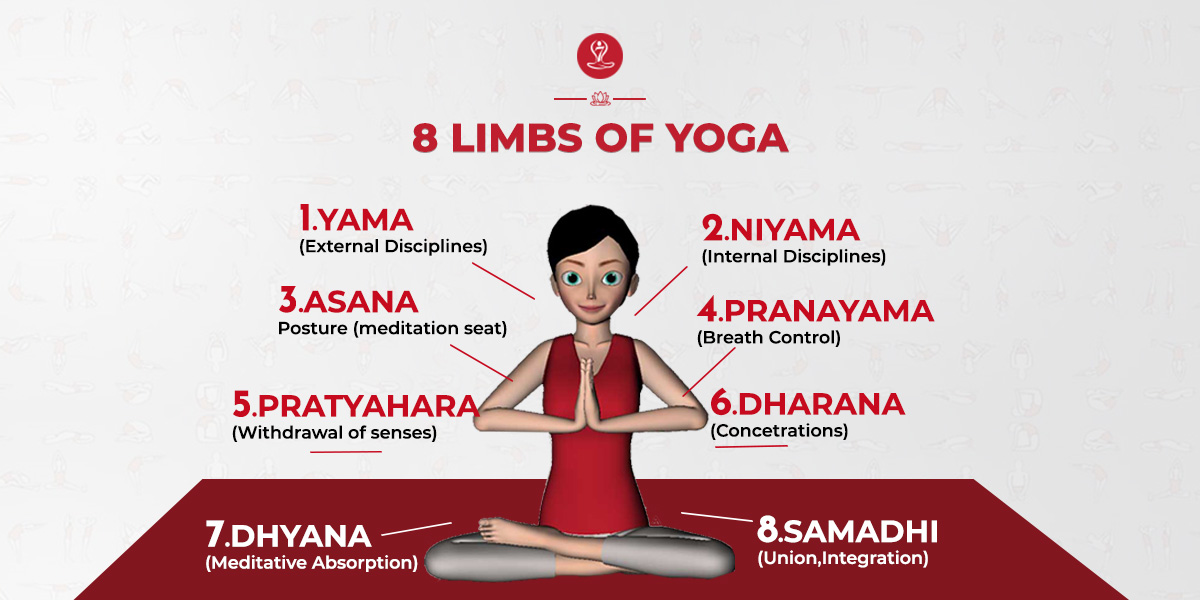
From Yama to Samadhi: Everything About the 8 Limbs of Yoga
The renowned Yoga Sutras of Patanjali outline the 8 limbs of yoga, each offering profound guidance on living a purposeful[...]

Jul 17, 2024
Transform Your Life with the 5 Yamas of Yoga
According to Sage Patanjali’s Yoga Sutras, from eight limbs of yoga the first limb of yoga, Yamas (Restraints), refers to[...]
RECENT POSTS


Disclaimer
The content is purely informative and educational in nature and should not be construed as medical advice. Please use the content only in consultation with an appropriate certified medical or healthcare professional