
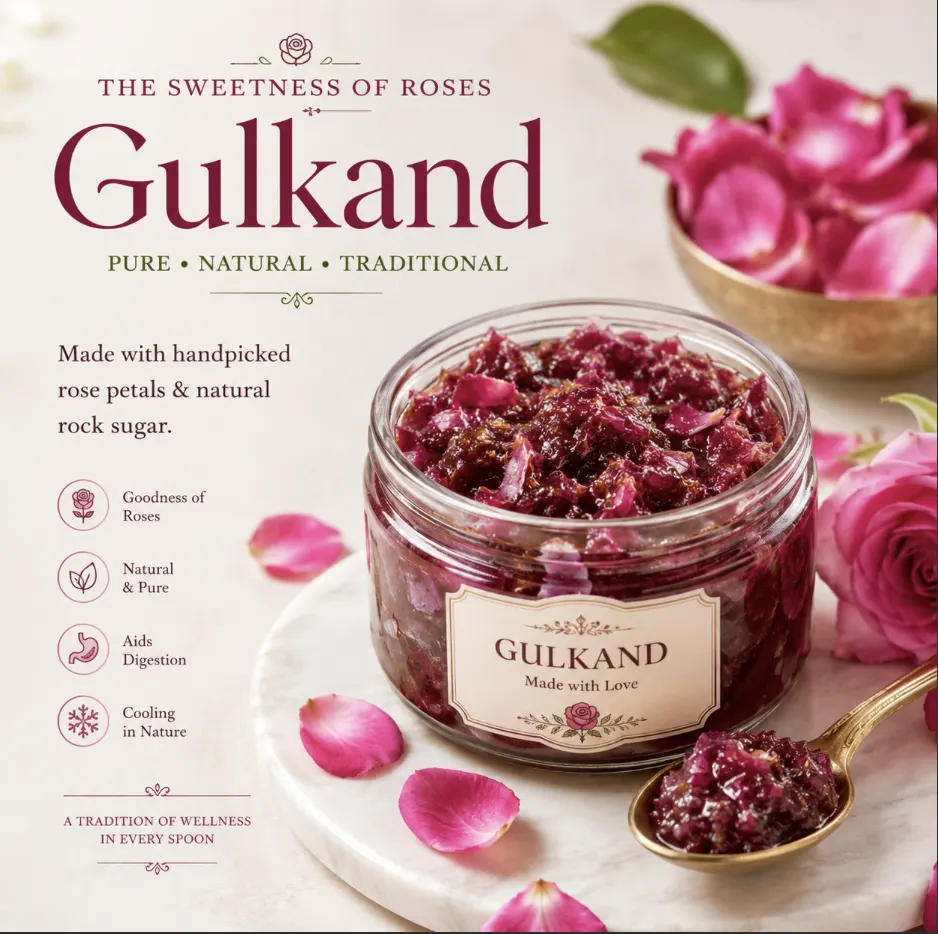
There’s a small glass jar that sits in most Indian kitchens — tucked behind the pickle bottles, half-forgotten until summer hits hard. Inside is something that looks like dark rose-coloured jam, smells like a garden after rain, and tastes like someone decided to preserve pure comfort. That’s gulkand. And somehow, the modern world is only just catching up to what our grandmothers already knew.
What actually is it?
Gulkand is nothing more than rose petals and sugar, layered and left to slow-cook in the sun. The name itself tells you — gul means flower in Persian, qand means sugar. No fire, no boiling, no preservatives. Just patience and sunlight doing the work over two to three weeks. The result is a thick, fragrant preserve that carries the full depth of the rose — not the synthetic sweetness of rose essence, but something earthier, warmer, almost wine-like.
It has roots in Ayurveda and Unani medicine going back centuries. This wasn’t a dessert ingredient — it was medicine. Cooling, calming, digestive medicine that happened to taste extraordinary.
“The thing about gulkand is that it doesn’t announce itself. It works quietly — the way the best remedies do.”
Why people are reaching for it again
Every summer in North India, gulkand makes its rounds. It goes into paan, into cold milk, into sherbets, into the mouths of children who just got back from playing in 44-degree heat. Because that’s its oldest job — cooling the body from the inside.
Ayurveda classifies roses as sheetal — cooling in nature. Gulkand takes that property and concentrates it. People eat a spoonful in the morning and swear by it for heat-related exhaustion, acidity, restlessness, even troubled sleep. Whether you lean into the Ayurvedic framework or not, generations of lived experience are hard to dismiss entirely.
There’s also something to be said for the gut. The slow fermentation that happens during sun-curing produces something closer to a probiotic food than a simple preserve. It’s gentle on the stomach and has long been used to ease constipation and hyperacidity — two things the modern diet practically guarantees.
The petals matter more than you think
Good gulkand is made with Damask roses — the variety called Desi gulab in India. They’re the small, intensely fragrant ones you find at temple flower stalls, not the large, watery florist roses bred for looks. The difference in flavour is enormous. Florist roses make a flat, faintly floral jam. Desi gulab makes something that actually tastes like it came from a rose.
If you’re buying readymade gulkand, the ingredient list should be embarrassingly short: rose petals, sugar. Maybe cardamom. That’s it. Anything longer is a red flag.
Making it at home is almost meditative
The process is beautifully slow and requires almost no skill:
Take fresh, fragrant rose petals — washed and completely dry. Layer them in a glass jar with an equal weight of mishri (rock sugar) or raw sugar. Press them down, seal the jar, and place it in direct sunlight every day. Stir it gently every couple of days. In two to three weeks, the petals will have collapsed into a dark, syrupy preserve, and your house will smell like a rose garden. The waiting is the hard part.
How to actually eat it
A spoonful straight from the jar is the most honest way. Beyond that — stir it into cold milk for a gulab doodh that beats any flavoured milk powder. Add it to lassi. Spread it inside paan. Mix it into vanilla ice cream and watch people ask what you did differently. A small amount in warm (not hot) oats or porridge is genuinely lovely. You can even dissolve a spoon in water with a few drops of lemon for a quick summer drink that tastes far more refined than it has any right to.
The rule is: a little goes a long way. A teaspoon or two a day is plenty. It’s rich, it’s sweet, and overusing it defeats the purpose.
Gulkand is one of those things that exists at the exact intersection of food and care — the kind your grandmother expressed not through words but through what she kept in her kitchen. It doesn’t need rebranding or a wellness influencer to validate it. It just needs a sunny windowsill and a little patience.
Put it in your pantry. You’ll reach for it more than you expect.
Conclusion
Some things don’t need reinventing — they just need remembering. Gulkand has survived centuries not because it was marketed well, but because it actually works and actually tastes good. In a world chasing the next superfood, there’s something quietly radical about a jar of rose petals and sugar sitting in the sun. Simple, honest, and unhurried. Exactly the kind of thing we could use more of.
