
Hasta mudras, or hand gestures, are a form of ancient Indian healing that is believed to help balance the body’s energy and promote overall health and well-being. Mudras can improve organ system functioning by stimulating specific acupressure points on the hands.
Mudras are believed to help balance the body’s energy, which can promote overall health and well-being. When the body’s energy is balanced, the thyroid gland can function more effectively.
Additionally, mudras can help reduce stress levels, improve circulation in the body, and promote relaxation, which can help deliver nutrients and oxygen to the thyroid gland. It can improve the function of the gland and reduce the symptoms of thyroid disorders.
Mudras are hand postures, according to Ayurveda, that activates specific energy pathways in the body, called Nadis, which can help balance the three doshas (vata, pitta, and Kapha) and improve overall health.
Specific mudras, such as the Shunya mudra, are particularly believed to promote calmness and relaxation by reducing the air element in the body.
Similarly, by practicing mudras that balance the Vata dosha and Kapha dosha, you can help reduce the risk of problems with the thyroid gland (hypothyroidism).
However, there is no scientific evidence to support the effectiveness of mudras for treating thyroid disorders, there are several ways in which they may be beneficial for hypothyroidism and hyperthyroidism:
Hasta Mudras for Thyroid Problems
There are several mudras that can help alleviate thyroid problems. Here are some of the most effective ones:
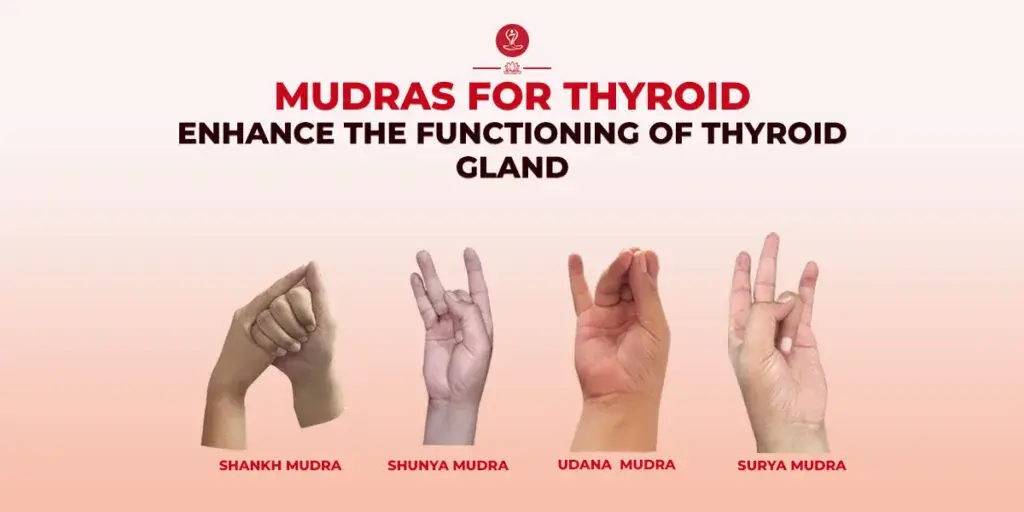
Shankh Mudra
Shankh mudra is a hand gesture that is believed to have several health benefits, including for the thyroid gland. It is also known as the conch shell mudra.
Consistent practice of the Shankha Mudra along with the chanting of Om helps you avoid mental confusion that prevents you from listening to your inner guidance.
To practice Shankh mudra, follow these steps:
- Sit in a comfortable position with your back straight and your palms facing upwards on your knees.
- Bring your left hand in front of your chest with the palm facing outwards.
- Clasp the fingers of your right hand around the left thumb.
- Place the tips of your right thumb, index, and middle fingers on the base of your left thumb, where it joins your hand.
- Hold the mudra for 15-30 minutes, while taking slow and deep breaths.
Hansi Mudra (Inner Smile Mudra)
Hansi Mudra is a hand gesture that is believed to have several health benefits, including balancing the throat chakra. Inner Smile Mudra is also said to stimulate the Vishuddha Chakra (Throat Chakra).
This traditional practice of yogic hand gesture is also known as Udana Vayu or Udaan Mudra because it focuses on balancing the Udana Vayu in the body.
Udaan mudra is believed to stimulate the thyroid gland and improve its function. This can help balance hormone levels, regulates metabolism, and alleviate symptoms of thyroid disorders for both hypothyroidism and hyperthyroidism.
To practice Hansi mudra, follow these steps:
- Sit in a comfortable position with your back straight and your palms facing upwards on your knees.
- Touch the tips of your thumb, index, middle, and ring fingers together, while keeping your little fingers extended.
- Focus your attention on your throat area, where the thyroid gland is located.
- Hold the mudra for 15-30 minutes, while taking slow and deep breaths.
Shunya Mudra
Shunya mudra is believed to stimulate the thyroid gland and balance the thyroid hormones. It may also help to reduce stress and anxiety, which can contribute to thyroid issues. However, it is important to note that Shunya mudra should not be used as a substitute for medical treatment for thyroid problems.
To practice Shunya mudra, follow these steps:
- Sit in a comfortable position with your back straight and all you have to do head facing forward and your hands on your laps.
- Bring your middle finger down to the base of your thumb, and gently press it with your thumb.
- Extend your other three fingers straight out.
- Start with 10 minutes a day, and gradually practice up to 45 minutes a day.
Surya Mudra
Surya mudra is believed to activate the fire element in the body, which can help to balance the thyroid hormones. It may also help to boost metabolism and promote weight loss, which is often associated with thyroid problems.
To perform Surya mudra, follow these steps:
- Sit in a comfortable position with your back straight and your hands resting on your knees.
- Bring your ring finger down to the base of your thumb, and gently press it with your thumb.
- Extend your other three fingers straight out.
- In addition, it should be done with both hands simultaneously.
- Hold the mudra for 15-30 minutes each day, either in one sitting or in multiple sessions throughout the day.
Conclusion
It is important to note that mudras should be practiced regularly and consistently in order to see results. Additionally, it is important to consult with a healthcare professional before starting any new practices for thyroid problems.
Overall, mudras can be a helpful complementary therapy for thyroid problems, but it is important to note that they should not be used as a replacement for medical treatment.
FAQ
Shankh Mudra is one of the most commonly practiced mudras for supporting thyroid wellness. Other beneficial mudras include Prana Mudra, Udaan Mudra, and Surya Mudra. These mudras are traditionally practiced alongside pranayama and meditation to promote relaxation and energy balance.
No. Yoga mudras cannot cure hypothyroidism or hyperthyroidism. They should be used as a complementary wellness practice along with prescribed medications, regular medical check-ups, a balanced diet, and healthy lifestyle habits.
Most yoga experts recommend practicing thyroid mudras for 15–20 minutes daily. Beginners can start with 5–10 minutes and gradually increase the duration as they become comfortable with the practice.
Yes. Yoga mudras are generally safe for daily practice when performed correctly. Consistency is more important than practicing for long periods occasionally. If you have any medical concerns, consult your healthcare provider before starting.
Gentle breathing exercises such as Nadi Shodhana (Alternate Nostril Breathing), Ujjayi Pranayama, and Bhramari Pranayama are commonly combined with thyroid mudras to encourage relaxation and mindful breathing.
Absolutely. Most thyroid mudras are beginner-friendly and easy to learn. Start with simple hand positions, maintain a comfortable posture, and practice consistently for the best experience.
The ideal time is early in the morning on an empty stomach. However, you can also practice in the evening, provided you wait at least 2–3 hours after a meal.
Yes. Avoid practicing immediately after a heavy meal, do not strain your fingers, and continue taking your prescribed thyroid medication. Yoga mudras should support—not replace—professional medical treatment.
