
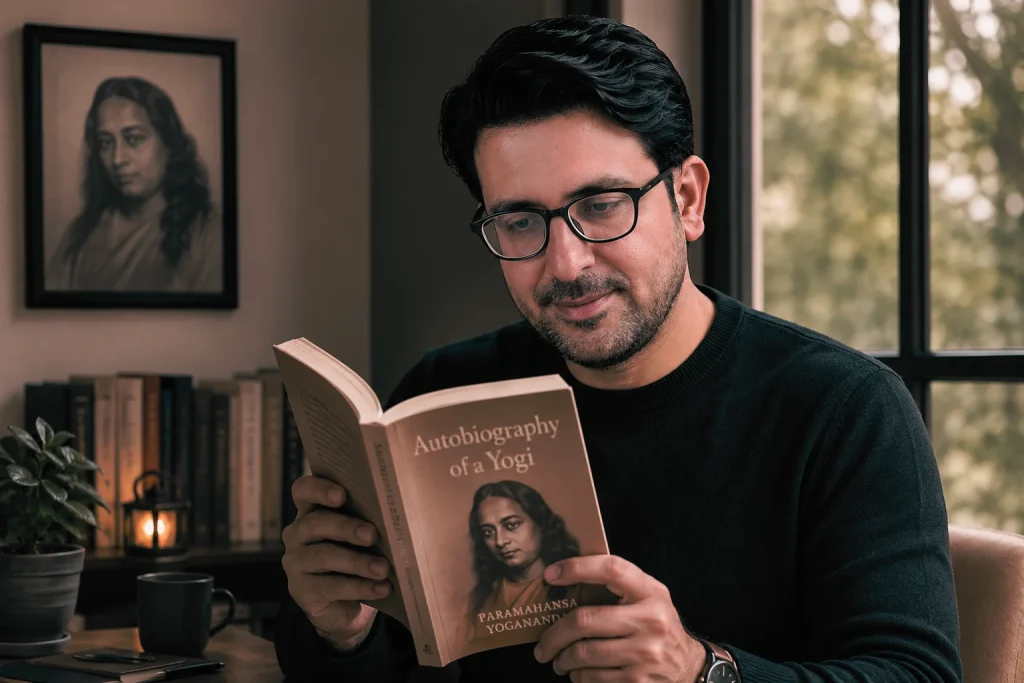
How the Autobiography of a Yogi author Paramahansa Yogananda brought Kriya Yoga into modern life
When I first moved into my engineering hostel, one thing kept surprising me.
Some of my classmates had the same book on their desks — Autobiography of a Yogi.
At first, I didn’t understand.
I thought, What kind of book is this?
I casually flipped through a few pages and moved on.
But then something interesting happened.
Whenever I met new friends, especially those interested in spirituality, motivation, or personal growth, I kept seeing the same book again.
So I asked them:
“Why does everyone have this book?”
And almost every time, the answer was similar:
“This is one of the best books you’ll ever read.”
Whether it was in motivational videos, seminars, spiritual discussions, or self-growth communities, people constantly recommended reading Autobiography of a Yogi at least once in life.
Eventually, curiosity won.
I found the book, read it, and discovered that it was far more than just a spiritual autobiography.
It became a doorway into the teachings of Paramahansa Yogananda, one of the great spiritual masters who introduced yoga and meditation to the Western world.
Through this article, I want to share what I personally learned from Yogananda’s teachings and how his wisdom can still transform modern life.
Who Is Paramahansa Yogananda?
Paramahansa Yogananda was a spiritual pioneer. In 1920, he traveled from India to America to prove that the spiritual techniques of the East were compatible with the scientific mind of the West. He didn’t ask people to “blindly believe”; he asked them to “experiment” with meditation.
His Mission
- Harmonizing East and West: Showing that inner peace and outer success can go hand-in-hand.
- Kriya Yoga: A specific, ancient technique that speeds up human evolution by directing energy around the spine.
- Self-Realization: Defining religion not as a dogma, but as a direct, personal experience of the Divine.
Deep Dive: The Science of the Soul
Yogananda’s teachings are unique because they treat the human body like an electrical battery.
1. The Body as a Rechargeable Battery
Yogananda taught that we are surrounded by cosmic energy. Just as you plug a phone into a socket, you can “plug” your body into this energy through Energization Exercises. He emphasized that a weak body makes for a weak mind. By keeping the body vibrant, we make it easier to sit still and meditate.
2. The Mechanics of Willpower
He famously said: “The greater the will, the greater the flow of energy.” If you have ever felt tired but suddenly got excited about a trip and felt a burst of energy, you’ve experienced this. Yogananda taught how to trigger that energy “on demand” through willpower.
3. Kriya Yoga: The “Airplane Route”
While many paths take a long time to show results, Yogananda called Kriya Yoga the “airplane route” to God. It works directly with the nervous system and the spine, helping to quiet the breath and still the mind faster than simple seated contemplation.
4 Pillars of Wisdom for the Modern World
Beyond the biography, his teachings offer a blueprint for surviving the 21st-century’s “attention economy”:
- Direct Experience Over Blind Belief: In an era of “fake news” and loud opinions, Yogananda’s insistence on Pratyaksha (direct perception) is refreshing. If your meditation doesn’t make you calmer and kinder, change your technique.
- Plain Living, High Thinking: Our lives are cluttered with notifications and gadgets. Yogananda suggests that the more we simplify our physical needs, the more “bandwidth” we have for high-level creative and spiritual thinking.
- The Power of Environment: He warned that “environment is stronger than willpower.” If you want to be a yogi, hang out with calm people. If you want to be an achiever, surround yourself with doers.
- Joy is a Choice: He taught that we shouldn’t wait for the “perfect day” to be happy. Instead, we should carry a “portable paradise” within us at all times.
Key Lessons I Learned from Autobiography of a Yogi
Direct Experience Over Blind Belief
One of the strongest lessons was this:
Don’t just believe in peace, bliss, or higher consciousness.
Practice until you feel it.
Plain Living, High Thinking
Yogananda encouraged simplifying external distractions so inner awareness can grow.
Environment Shapes Consciousness
Your company matters.
He emphasized Satsang — surrounding yourself with uplifting, wise, and spiritually aligned people.
Joy Is Your True Nature
A major insight:
Happiness is not dependent on circumstances.
Joy is already within.
Practical Ways to Apply Yogananda’s Teachings
Energy Exercises
Practice conscious breathing and body awareness to channel life energy.
Stillness Practice
Even 10 minutes of silence daily can deeply reset your nervous system.
Learn and practice Positive Affirmations.
Final Thoughts
Reading Autobiography of a Yogi was not just reading a book.
It felt like discovering a new possibility of life.
Yogananda taught me that spirituality is not escape.
It is inner science.
Just as awareness helps us question our thoughts, energy practices help us elevate our consciousness.
Together, they create a complete path toward:
- Wellness
- Mental clarity
- Spiritual growth
- Inner bliss
If you have never read Autobiography of a Yogi, I genuinely believe it is a book worth experiencing at least once.
It may not just change what you think.
It may change how you live.
AI Disclosure: At 7pranayama, we occasionally use AI tools to help structure our content and improve readability. However, the core expertise, final review, and “human touch” come from our certified instructors. Our goal is to provide you with the most up-to-date, high-quality wellness information possible.
