
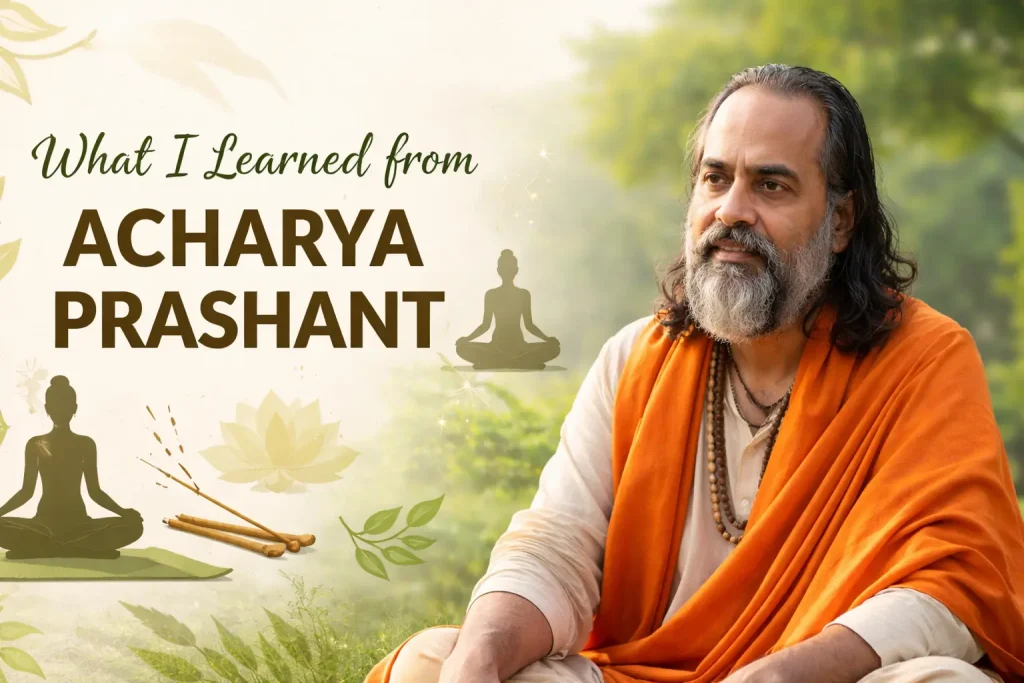
I first discovered Acharya Prashant videos while casually browsing YouTube. I was not searching for anything specific, but one video caught my attention.
His calm presence and direct way of speaking felt different from typical motivational content. It was not emotional or flashy—it was focused and sharp.
At that time, I did not fully understand his ideas. But the curiosity led me to explore more Acharya Prashant teachings, especially on the mind, awareness, and Vedanta philosophy explained in simple language.
I started exploring deeper topics like the mind, self-inquiry, and Vedanta. This article is based on my personal understanding and learnings from those videos.
Who Is Acharya Prashant?
Acharya Prashant is a contemporary spiritual teacher and author known for his talks on Vedanta and self-inquiry.
He mainly focuses on:
- Explaining ancient Indian philosophical texts like the Upanishads
- Answering practical life questions through a philosophical lens
- Helping people understand the mind and its patterns
- Encouraging self-awareness and questioning of beliefs
His approach connects traditional Vedantic ideas with modern life situations like relationships, stress, and decision-making.
Core Idea Behind Acharya Prashant teachings
From what I understood, the central focus of his teachings is the study of the mind.
He often highlights that:
- Most human suffering comes from the mind’s conditioning
- We live based on learned patterns rather than clear awareness
- Real clarity comes from questioning these patterns deeply
- Knowledge is not just theoretical, but something to be reflected upon in daily life
His teachings are often linked with Jnana Yoga (the path of knowledge), a branch of yoga where self-inquiry plays a key role in understanding reality and oneself.
You can understand it like this: different teachers focus on different paths of yoga. Some teach Bhakti Yoga (path of devotion), while others focus on Hatha Yoga (physical postures and breath control), and some emphasize Jnana Yoga (knowledge and self-inquiry).
Each path has its own approach, but the goal is to help a person understand life and inner awareness in a deeper way.
My Personal Learnings from His Videos
Here are some key insights I personally took from watching his talks:
1. Understanding the Mind is Important
One of the strongest ideas I noticed is the focus on observing the mind.
The mind often:
- Creates unnecessary fear
- Repeats old habits
- Builds confusion through overthinking
By becoming aware of these patterns, we can reduce internal conflict.
2. Questioning Our Actions and Beliefs
A recurring theme is self-questioning.
Instead of blindly following habits or beliefs, the idea is to ask:
- Why am I reacting this way?
- Is this thought truly mine or learned?
- What is influencing my decisions?
This kind of inquiry can bring more clarity in daily life.
3. Simplicity in Thinking
Another important learning is simplicity.
Many problems in life feel complex, but often:
- Overthinking increases confusion
- Clear observation reduces mental pressure
- Simple understanding is more powerful than complicated reasoning
This approach encourages reducing unnecessary mental noise.
4. Practical Approach to Philosophy
What I found interesting is how philosophical ideas are connected to daily life.
Instead of keeping spirituality separate, the focus is on:
- Real situations
- Emotional reactions
- Relationships and decision-making
This makes the teachings more practical and relatable.
How These Ideas Can Be Applied in Daily Life
These learnings can be applied in small but meaningful ways:
- Pause before reacting emotionally
- Observe thoughts without immediately believing them
- Ask simple questions before making decisions
- Reduce overthinking by focusing on clarity
- Reflect on patterns that repeat in life
Even small changes in awareness can improve how we handle situations.
Important Note for Readers
This article is based on my personal understanding after watching several videos.
Different people may interpret the same teachings in different ways. I encourage readers to explore Acharya Prashant’s original videos for a deeper and more direct understanding.
This is not an official explanation of his work, but a personal reflection.
🔄 My Ongoing Learning
I am still regularly watching Acharya Prashant videos and learning from his teachings on Vedanta, mind, and self-inquiry.
This article is not a final conclusion.
As I continue exploring his ideas, I will:
- Update new insights here
- Add deeper understandings of Vedanta philosophy
- Refine my interpretation of self-inquiry
- Include practical real-life applications
Final Thoughts
Discovering philosophical content often starts with curiosity. In my case, it began with a random video, but gradually led to deeper reflection on the mind and life.
The key takeaway for me is simple: awareness changes how we experience life. The more clearly we observe ourselves, the more grounded we become in daily situations.
