
“Yoga” is a form of art practiced by yogis (Hindu monks) all over the world. yoga refers to specific mudras and attitudes. Mudras help in creating a balance between the five elements and enhance the smooth energy flow in the human body. mudra is known as “energy seal”, This has been the practice of our ancestors for years. Some yoga mudras are comfortable for us. Just by touching the hands with our fingers, we can influence our tendency, thinking. Like Gyan mudra, Varun mudra, Agni mudra, Shunya mudra, and Adi mudra.
Mudras are mostly physical activities that can be used to seal energy and heal the body with inner strength. As a well, they are great companions of the meditative practices with your asana-pranayama session.
This article reviews the Yoga science behind Adi mudra and its potential health benefits.
Adi Mudra
Adi Mudra received its name, Adi means first or primal, and Mudra means to seal or gesture. because it is the first position of hands are capable of inside the womb. Often we see newborn babies with this hand gesture. That’s why this Mudra has been associated with the Primordial Mudra and The babies’ Gestures because it is the first position an infant can make with the hands.
Entirely distinct and based on the principle of Ayurveda, It is a symbolic, ritualistic gesture of the hands. That is often used in a spiritual yoga practice to calm and quiet the mind and nervous system. Also, it is most commonly practiced during Pranayama as well as Meditation.
How to Do Adi Mudra?
First of all, sit in any comfortable seating posture and place the hands with palm pointing upwards on the thighs or the knees.
- Meditation postures like Padmasana, Siddhasana, and, Vajrasana, etc. are ideal for the practice of mudras.
- Close your eyes and take some deep breaths with the awareness of the breathing process.
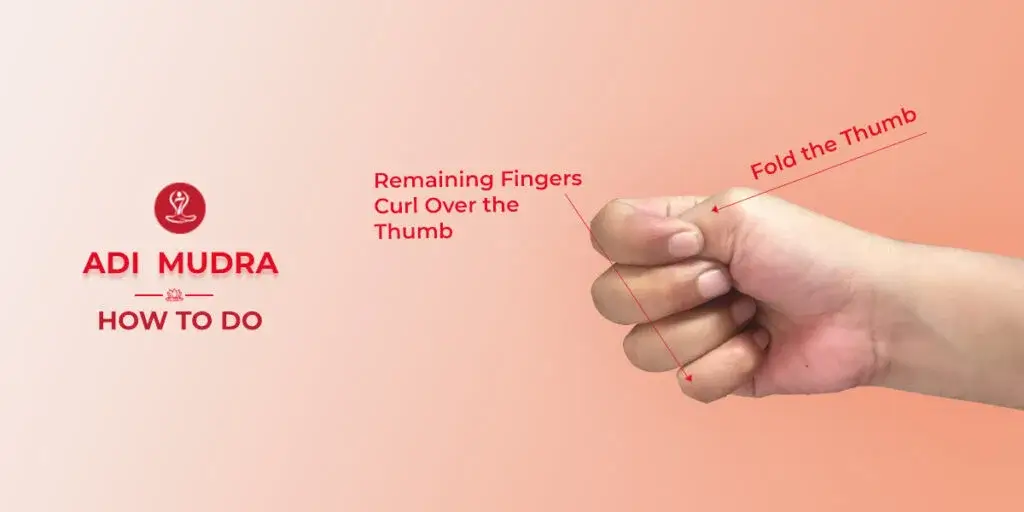
- Now fold your thumb and thumb is placed at the base of the small finger.
- The remaining fingers curl over the thumb, putting pressure over the outer thumb and making a gentle fist.
- Removing all thoughts from the mind has to focus the mind only on OM.
- In addition, it should be practicing with both hands simultaneously.
- Do not decrease or increase the speed of breath from your side.
- Perform this pose for 30 minutes at a stretch every day or for 10 to 12 minutes three times a day.
- You can practice this Mudra by standing in Tadasana Yoga (Mountain pose), otherwise sitting on a chair.
This mudra is beneficial for the body in many ways, it helps in curing various types of diseases, let us know the benefits of Adi mudra in detail.
Adi Mudra Benefits
It is believing Adi mudra has a lot of spiritual, mental, and emotional benefits.
- Adi mudra increases breathing as well as lung capacity, thus increasing oxygen flow throughout the body.
- It increases mental activeness and improve your motor skills, which is related to the crown (Sahasrara) chakra.
- Improves the flow of oxygen to the head and throat.
- It is beneficial in balancing and healing the sense organs.
- The Adi mudra is also thought to stimulate the calms and soothes the nervous system.
- This also helps to reduce snoring.
- Also helps incontrol musculoskeletal system.
- Morever, it stimulates to endocrine gland and strengthens respiratory muscles.
Time and Duration
All mudra has recommended duration of about 45 minutes a day. You can breaking up the practice into three sets of 15 minutes each throughout the day can be a helpful approach, especially for beginners who may find it challenging to sustain focus and endurance for a full 45-minute session at once.
By breaking up the practice, you give yourself time to rest and integrate the effects of the mudras, while also making it more manageable to incorporate into your daily routine. This approach allows for flexibility and can help prevent fatigue or strain that may arise from prolonged periods of practice, particularly for those who are new to mudras.
Side Effects
However, all mudras are beneficial to us without any side-effects. pressure should not be applied on the finger. Pressure means, your mind is restless and not stable. As a result, nothing at all. Perform this mudra freely.
Conclusion
Continuous practice of Adi Mudra will bring positivity within you. As its qualities are, It is a weapon that gets rid of weakness, dullness, and laziness and improve your motor skills as well as strengthens respiratory muscles.
FAQ
Adi Mudra is a traditional yoga hand gesture where the thumb is folded into the palm and covered by the fingers. It is commonly practiced during meditation and pranayama to promote relaxation, improve breath awareness, and support mental calmness.
Adi Mudra may help reduce stress, encourage deep breathing, improve concentration, promote relaxation, and prepare the mind for meditation. Regular practice can support overall mental well-being when combined with a healthy lifestyle.
Beginners can start with 5–10 minutes daily and gradually increase to 15–20 minutes as they become comfortable. Practicing consistently is generally more beneficial than practicing for long periods occasionally.
The best time is early morning during meditation or pranayama on an empty stomach. However, it can also be practiced in the evening or whenever you need to relax and refocus.
Yes. Adi Mudra is easy to learn and suitable for beginners. Maintaining a comfortable posture and practicing with slow, deep breathing can help you get the most from the practice.
Adi Mudra is traditionally used to encourage relaxation and mindfulness, which may help reduce feelings of stress and promote emotional balance. It should not replace professional medical or psychological treatment.
Adi Mudra is often practiced with pranayama to promote slow, controlled breathing and greater breath awareness, making it a useful addition to breathing exercises.
Adi Mudra is generally considered safe when practiced gently. Avoid gripping the fingers too tightly or forcing the posture. If you experience discomfort or have a medical condition, consult a healthcare professional or qualified yoga instructor.
