
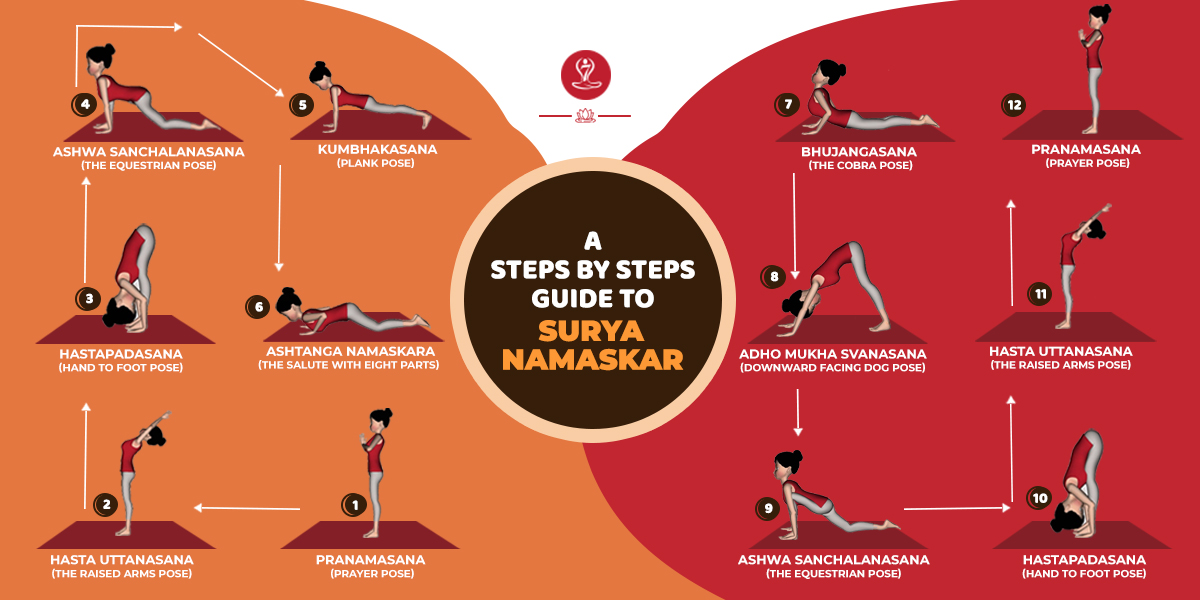
One of the tremendous Yoga practices is Surya Namaskar or Sun Salutation, which is a sequence of 12 powerful yoga poses. This is the best exercise for the human body, as it incorporates important Yoga Poses and Pranayama.
It is derived from the Sanskrit word Surya, meaning the “Sun,” the source of all forms of life on the earth. and Namaskar, meaning a greeting to the revered Sun god in its honor and assimilating the faith to its divine presence on our world and impact on our body.
Why Surya Namaskar?
Because every sunrise deserves a greeting—and your body deserves the energy it brings. Surya Namaskar awakens your inner vitality, purifies your mind, and balances your spirit. With every flow, it activates dormant energies, sweeps away lethargy, and nourishes your system with a natural, radiant glow.
What is the Best Time to do Surya Namaskar?
The magic hour is sunrise—when the world is still, the sky glows softly, and your breath syncs effortlessly with nature. Practicing Surya Namaskar at this time awakens your inner fire and sets a powerful tone for the day.
How many asanas are there in Surya Namaskar?
In the classical version of Surya Namaskar, you move through 12 asanas, each designed to activate different energy channels, or nadis, making the sequence a complete spiritual and physical practice.
Let us look at 12 Surya Namaskar Steps:
Step 1. Pranamasana (Prayer Pose)
- At first, you need to stand at the mat’s edge in Mountain pose by bringing your legs together.
- Inhale and lift both of your arms up.
- Now, exhale in a calm fashion, bringing your palms to the front of your chest in the position of prayer.
Breath – Inhale
Chakra – Heart (Anahata)

Step 2. Hasta Uttanasana (The Raised Arms Pose)
- Fill deep inhale and move both hands upwards. Now tilt the arms and the neck back towards the back with your back from the waist.
- Remember to keep the biceps close to your ears. The goal is to stretch the entire body.
Breath – Inhale
Chakra – Throat (Vishuddhi)

Step 3. Hastapadasana (Hand to Foot Pose)
- Exhale and fold forward by keeping your palms pressed downwards with fingertips in line with the toes.
- Bend your knees if you feel discomfort at first. It will improve over time, and you will achieve a straight-legged position.
- Now exhale and bring your hands down to the floor just beside your feet.
Breath – Exhale
Chakra – Root (Muladhara) chakra is activated in these steps of Surya Namaskar
About Hastapadasana Yoga :
Derived from Sanskrit words, Hasta meaning hands, Padah meaning foot, and Asana meaning posture, it is an exuberating Yogic exercise. However, it requires immense concentration.

Benefits of Hastapadasana Yoga :
- Strengthens your back muscles and makes them flexible.
- Helps in weight loss and reduces hair loss.
- Increases blood supply to the brain, boosting the nervous system.
- Cures digestive system disorders and removes belly fat.
- In women, it is associated with menstrual problems.
For more: Hastapadasana Yoga | How to do Standing Forward Bend | Benefits | Steps
Step 4. Ashwa Sanchalanasana (The Equestrian Pose)
- First, Inhale and push your left leg back as far as you possibly can.
- Now bring the right foot forward, placing it between your hands.
Breath – Inhale
Chakra – Third Eye (Ajna) chakra focuses on these steps.

Step 5. Kumbhakasana (Plank Pose)
- While retaining the breath, bring your other leg back.
- Support your weight on your toes and hands. Now, your body is in a straight line like a push-up position.
Breath – Hold (Breath in)
Chakra – Throat (Vishuddhi)

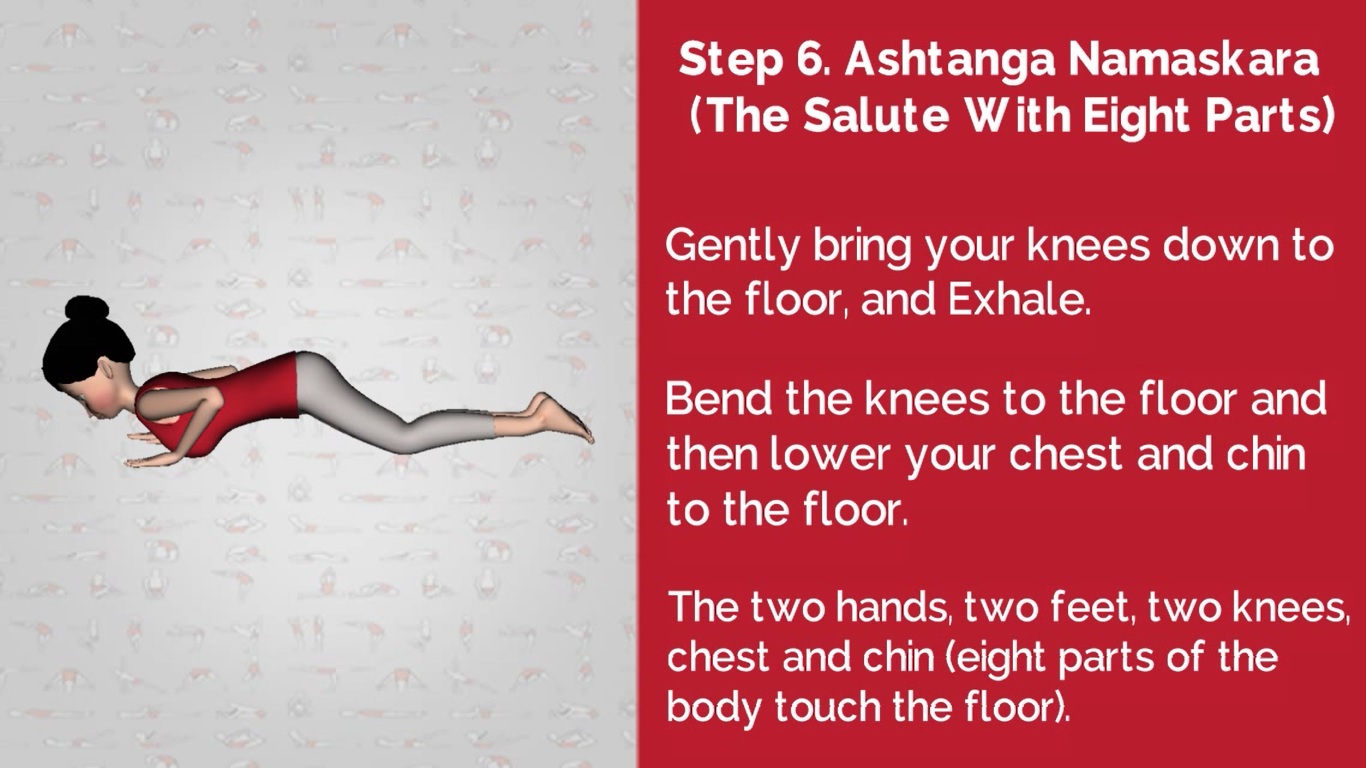
Step 6. Ashtanga Namaskara (The Salute With Eight Parts)
- Now bring your knees gently to the floor and exhale.
- Bend your knees to the floor.
- Lower your chin and chest to the floor.
- Your chin, chest, hands, knees, and feet, the eight body parts, will be touching the floor.
Breath – Exhale
Chakra – Spleen (Swadhisthana)
Step 7. Bhujangasana (The Cobra Pose)
- Inhale slowly and raise the upper body in the Cobra pose.
- Keep elbows bent and shoulders away from your ears.
- Now, look up.
Breath – Inhale
Chakra – Root (Muladhara)

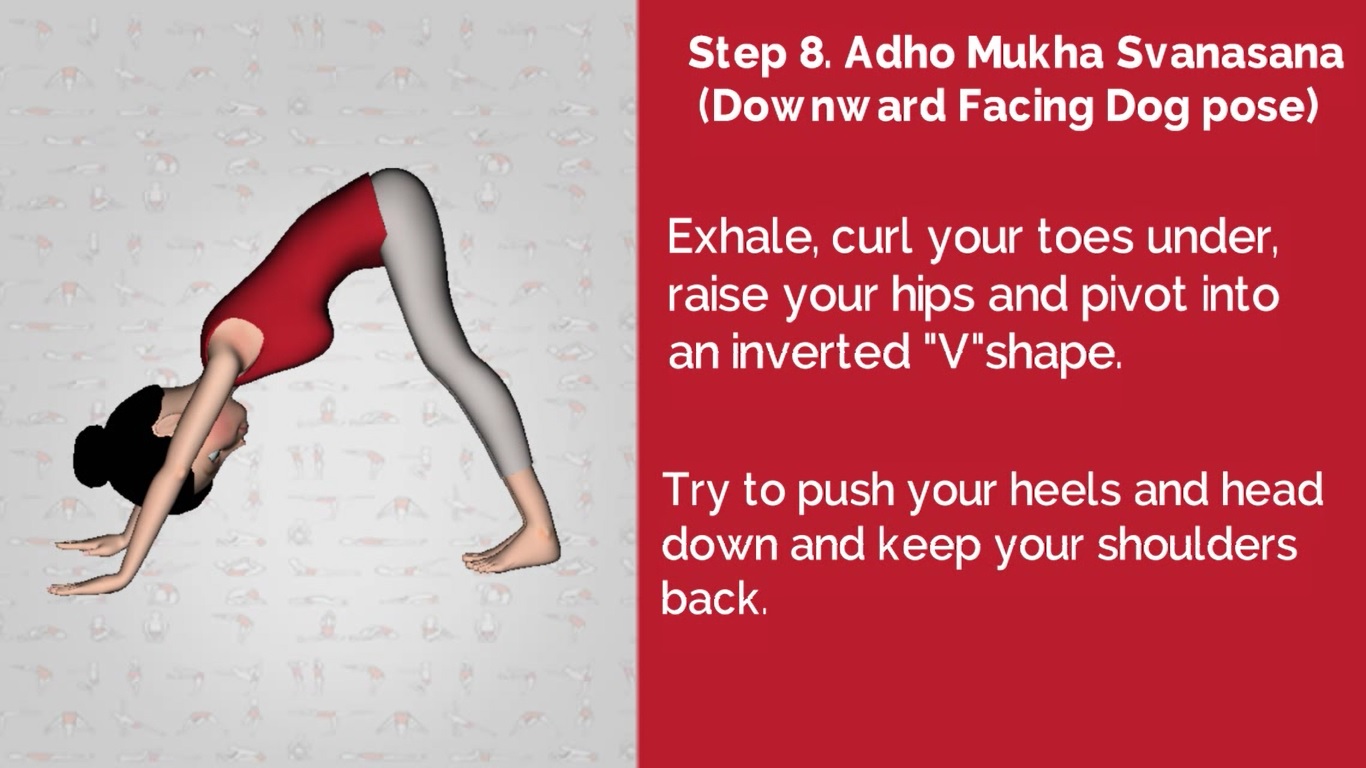
Step 8. Adho Mukha Svanasana
- Exhale and curl your toes under.
- Raise your hips and pivot them into an inverted “V” shape.
- Now, try to push your heels while keeping your head down and your shoulders back.
Breath – Exhale
Chakra – Throat (Vishuddhi)
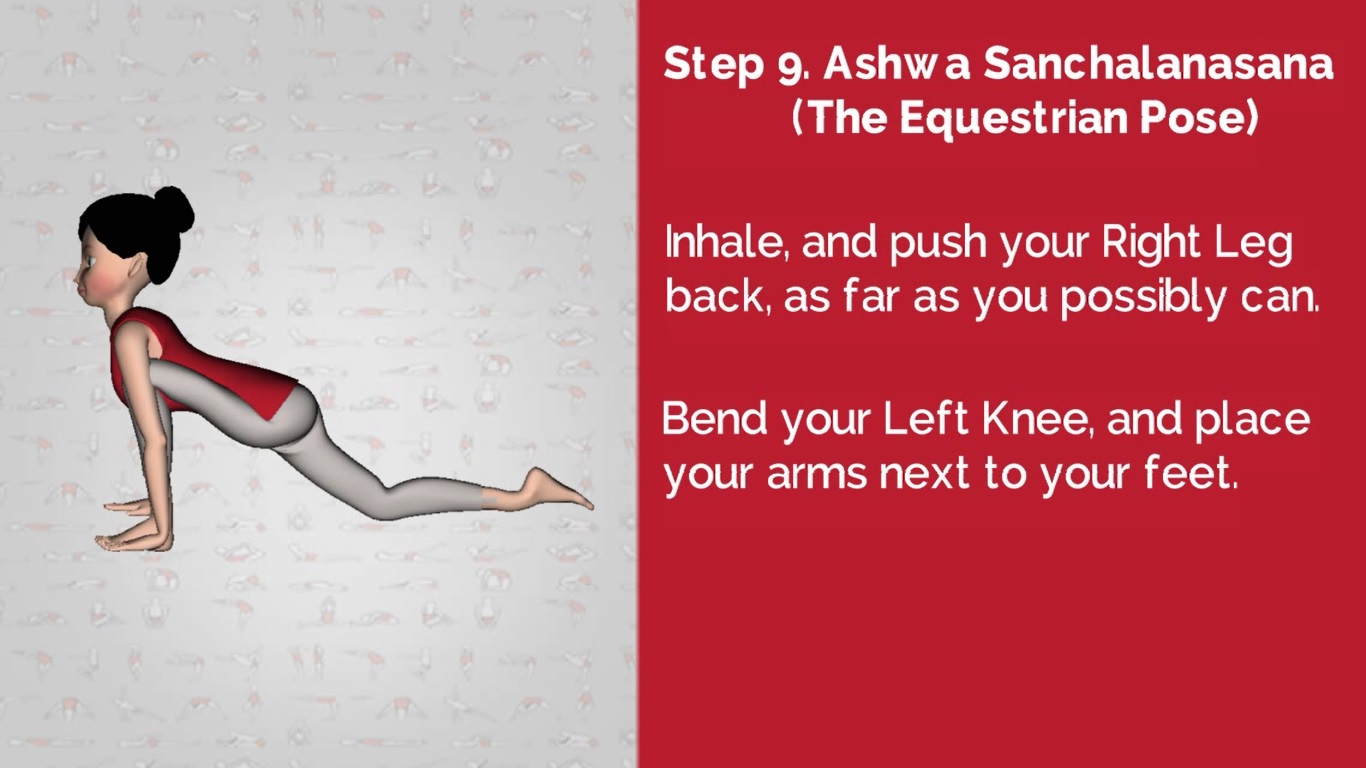
Step 9. Ashwa Sanchalanasana (The Equestrian Pose)
- Inhale and then push your right leg as far as possible.
- Bend your left knee.
- Place your arms right next to your feet.
Breath – Inhale
Chakra – Third Eye (Ajna).
Step 10. Hastapaadasana (Hand to Foot Pose)
- Exhale and fold forward.
- Press your palms down with fingertips in perfect line with the toes. In case of discomfort, bend your knees.
- As you exhale, bring down your hands to the floor right beside your feet.
Breath – Exhale
Chakra – Root (Muladhara) chakra

Step 11. Hasta Uttanasana (The Raised Arms Pose)
- Now, inhale and lift the arms up and back while keeping the biceps close to your ears.
- Try to put the effort into stretching your body.
Breath – Inhale
Chakra – Throat (Vishuddhi)

Step 12. Pranamasana (Prayer Pose)
- Finally, stand at the mat’s edge in the same Mountain pose with your legs together.
- This situation will remain similar to the first position. After performing the Surya Namaskar, do some respite.
- Exhale and bring your palms again in front of your chest in a prayer position.
Breath – Inhale
Chakra – Heart (Anahata)

“Practice Yoga and Pranayama: Download today 7pranayama app from the App Store or the Play Store”
Benefits of Surya Namaskar
Surya Namaskar is far more than a morning ritual—it is a complete wellness practice that nourishes every organ, strengthens the body, and balances the mind.
1. Strengthens the Nervous System & Activates Endocrine Glands
Surya Namaskar keeps the nervous system healthy and resilient. The flowing postures stimulate the endocrine system, especially the thyroid gland, helping to regulate hormones and maintain overall balance.
2. Enhances Concentration in Children
In today’s fast-paced world, children face intense academic and social competition. Practicing Surya Namaskar boosts their stamina, improves concentration, sharpens focus, and helps calm an overactive mind—making it extremely beneficial for growing kids.
3. Improves Lung Capacity & Oxygen Flow
Many practitioners believe that Surya Namaskar expands lung capacity by encouraging deep, rhythmic breathing. This increased oxygen supply purifies the blood, flushes out carbon dioxide, and enhances overall circulation.
4. Boosts Digestive Health
Regular practice enhances the functioning of the digestive system. It helps relieve constipation, gas, indigestion, abdominal discomfort, and poor appetite, while also strengthening the digestive tract for long-term health.
5. Reduces Excess Body Fat
Surya Namaskar is a powerful calorie burner. Its dynamic movements activate the core and abdominal muscles, making it especially effective in reducing belly fat and supporting weight management.
6. Supports Heart Health
By improving circulation and enhancing oxygen uptake, Surya Namaskar reduces the risk of lifestyle-related conditions such as heart disease, high or low blood pressure, diabetes, and arthritis.
7. Beneficial for Hair & Scalp
Improved blood circulation to the scalp may help in reducing premature greying and dandruff, while minimizing the chances of scalp infections.
8. Strengthens the Spine & Improves Flexibility
The sequence promotes a flexible waist and strengthens the spine. Each vertebra is stretched, aligned, and energized, enhancing overall mobility. It also helps expand and strengthen the chest region.
9. Tones and Supports Internal Organs
Surya Namaskar works deeply on the muscles, stomach, liver, kidneys, gallbladder, and even the diaphragm, improving their functioning and vitality.
10. Promotes Deep, Restful Sleep
With regular practice, the body relaxes naturally, allowing for deep, uninterrupted sleep without relying on sleep medications.
11. Supports Women’s Health
Surya Namaskar is particularly beneficial for women. It helps regulate irregular menstruation, boosts the reproductive system’s efficiency, and enhances hormonal balance.
12. Scientifically Supported Benefits
Research suggests that Surya Namaskar (SSN) can improve pulmonary function, respiratory pressures, and hand-grip strength and endurance, showing its profound effect on overall physical performance.
The sun always rises east, and practicing the east side face brings more positive energy.
Contradiction for Surya Namaskar (When You Should Avoid or Be Careful)
While Surya Namaskar is a powerful and beneficial practice, it is not suitable for everyone. Certain health conditions require caution, modification, or complete avoidance.
1. People with Heart Problems
2. Uncontrolled High Blood Pressure
3. Hernia Patients
4. Slipped Disc or Severe Back Pain
5. During Fever or Acute Illness
6. Pregnant Women
7. Individuals with Carpal Tunnel Syndrome
8. People with Vertigo or Balance Issues
9. Severe Arthritis
10. Recent Surgeries
11. During Menstruation (for Some Women)
12. Stomach Issues Right After Eating
Conclusion
Surya Namaskar is a simple yet transformative practice that energizes the body, sharpens the mind, and nurtures overall well-being. Just a few minutes daily can uplift your health, boost your mood, and bring balance to your life—one sun cycle at a time.
RELATED ARTICLES

Dec 23, 2025
Yoga for Cyclists: Improve Flexibility, Strength, and Endurance
Yoga for cyclists is strongly recommended for maintaining overall health and long-term performance. It is an ideal practice for everyone[...]

Dec 17, 2025
Yoga for Sex Health: Increase Stamina, Control & Sexual Confidence
To enjoy a healthy and fulfilling sex life, yoga is one of the safest and most natural approaches. Regular yoga[...]

Dec 03, 2025
How to Do Ashtanga Namaskara Correctly for Maximum Benefits
Ashtanga Namaskara, also known as the Eight-Limbed posture, is part of Surya Namaskara or Sun Salutation. It is the present[...]
RECENT POSTS


Disclaimer
The content is purely informative and educational in nature and should not be construed as medical advice. Please use the content only in consultation with an appropriate certified medical or healthcare professional