
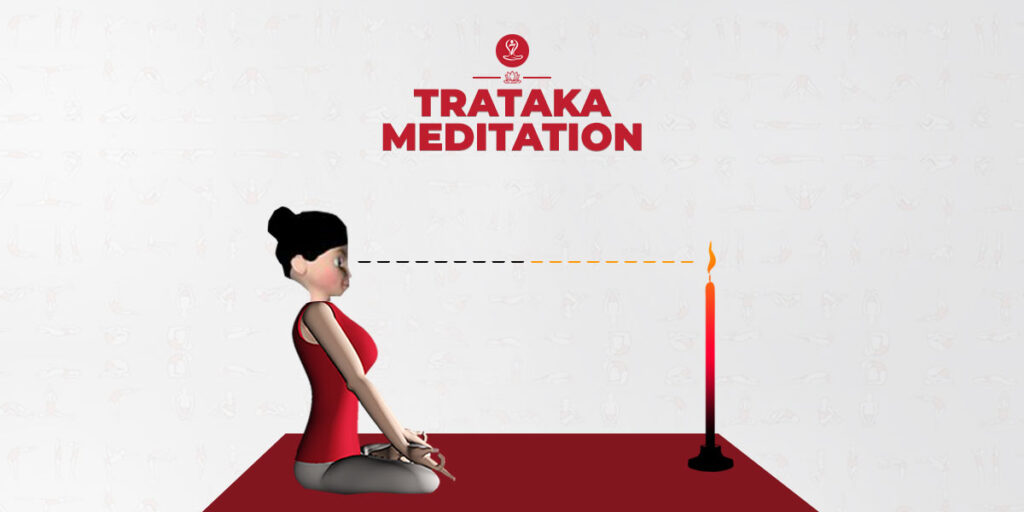
Trataka Meditation is a yogic practice from Hatha Yoga where the eyes are fixed on a single object without blinking. It strengthens eye muscles, improves concentration, increases mental strength, and helps achieve divine hidden powers.
What Is Trataka Meditation?
Trataka Meditation — also called Gazing Meditation — is the practice of concentrating the mind and eyes on a single object without blinking. It is one of the six Shatkarma of Hatha Yoga.
Trataka means to constantly look at a particular object with your eyes. It is a main technique of Hatha Yoga — described in ancient texts as the power to awaken vision and cleanse the internal organs.
Key facts about Trataka:
- One of the seven parts of Hatha Yoga and a Shatkarma (six actions)
- The eyes are considered the gateway to the soul
- Uses the eyes to establish contact between the soul and the mind
- Practiced to provide strength and purity to the body
When the eyes are kept steadily on an external object, the mind gradually converges at a single point. Over time, the practice develops the ability to control the mind’s infatuation and distractions.
What Objects Are Used in Trataka Meditation?
Trataka can be practiced using a candle flame, circular point, moon, sun, fire, or images and idols of deities and great figures — placed at eye level, about 3 feet away.
Common Trataka objects include:
- Images, idols, or symbols of deities or great figures
- Spherical or circular objects, a single point
- Candle flame or ghee lamp flame
- Moon, sun, or stars
- A tree or mountain (distant gaze)
Keep the object at eye level, approximately 3 feet away. Gaze without blinking and allow no thoughts to arise. Gradually the mind begins to calm down.
Why Is Trataka Meditation Important?
In the modern era of stress and negative thinking, Trataka Meditation redirects mental energy, eliminates unwanted thoughts, improves focus, and enables a stress-free, concentrated life.
Research shows that human beings spend enormous energy and time thinking unnecessary thoughts. Trataka gives the right direction to thoughts and energy.
Benefits of regular Trataka practice:
- Eliminates unwanted and negative thoughts
- Increases focus and concentration
- Removes disturbance and mental restlessness
- Enables a stress-free, calmer life
- Strengthens eye muscles
- Increases mental strength
- Helps achieve divine hidden powers
What Are the Types of Trataka Meditation?
There are five main types of Trataka Meditation — Candle Flame, Point, Moon, Tree, and Statue Trataka — each using a different object of focus.
Important: Always start Trataka from 2–3 minutes and gradually increase the duration. Consult an expert before beginning.
1. Candle Flame Trataka (Deepak Trataka)
A ghee or oil lamp — or candle — is lit and the practitioner concentrates on its flame. Continuous practice steadily increases concentration.
2. Point Trataka
A single point is drawn on a board or wall and the practitioner focuses their complete attention on it without blinking.
3. Moon Trataka
The practitioner gazes steadily at the moon after it rises each evening. This practice builds concentration and also brings a natural coolness and calmness to the mind.
4. Tree Trataka
The practitioner focuses attention on a distant tree or mountain. This was a common Trataka method practiced by sages and monks in ancient times.
5. Statue Trataka
The practitioner gazes at an idol or picture of a deity — starting from the feet and moving slowly upward to the head, then settling the gaze on one specific part.
What Are the 3 Stages of Trataka Meditation?
The three stages of Trataka are Inner (eyes closed, third eye focus), Middle (half-open eyes on candle or nose), and Outer (open-eyed gazing at moon, sun, or stars).
Stage 1 — Inner Trataka
Eyes are completely closed. Attention is directed inward toward the third eye — the point between the two eyebrows.
- Focus is directed entirely inside yourself
- Concentrate on the third eye (the space between the two eyes)
- You may feel mild pain in the third eye initially — this gradually
disappears with practice - Useful for removing negative thoughts and increasing intelligence
Stage 2 — Middle Trataka
Eyes are neither fully open nor fully closed. The practice is done gazing at a candle flame or the tip of the nose.
- A transitional stage between inner and outer Trataka
- Candle flame or nose tip are the most common focus points
- Develops steadiness of the gaze
Stage 3 — Outer Trataka
Eyes are fully open and fixed on the moon, sun, or stars — practiced in the afternoon or at night to calm the mind, improve concentration, and relieve mental disorders.
- Practiced with eyes fully open
- Objects: moon, sun, or stars
- Can be practiced in the afternoon or at night
- Keeps the mind calm and increases concentration
- Relieves mental disorders
How to Do Trataka Meditation Step by Step
Sit in Sukhasana with the spine straight, place your focus object at eye level 3 feet away, gaze without blinking until tears appear, close the eyes, rest, and repeat 3–4 times — gradually increasing duration over weeks and months.
Follow these steps:
- Sit in Sukhasana in a quiet room or environment.
- Keep the head, neck, and back straight.
- Place the object of focus at eye level, 3 feet away — a burning
candle, Shivling, or round white stone. - Fix your gaze on the object. Do not blink as long as possible.
- Keep both vision and meditation on the same object throughout — this
is essential for success in Trataka. - Continue gazing until the eyes become tired or tears appear.
- Close the eyes and relax completely.
- Repeat the process 3–4 times per session.
- Practice daily until you can gaze for 10–15 minutes without
blinking. - Gradually increase the duration over days and weeks.
What Is the Correct Progression for Trataka Practice?
Begin with a Shivling or candle flame, then progress to the nose tip, then the third eye, then distant objects like mountains and trees, and finally the moon, stars, and sun.
Follow this progression over weeks and months:
- Shivling or round stone — fix the sight first
- Candle flame — once the first is stable
- Nose tip — once the candle flame gaze is stable
- Space between the eyebrows (third eye) — may take several months
- Distant mountain top, temple dome, or tree branch
- Moon — once near objects are stable
- Stars — after the moon
- Sun’s reflection in water — start here for sun gazing
- Sun’s reflection in a mirror — next step
- The sun directly — the final stage
When vision remains stable for more than 32 minutes, the practitioner advances beyond Trataka meditation into higher states.
Conclusion
Trataka Meditation is a powerful, structured Hatha Yoga practice that sharpens concentration, strengthens the eyes, eliminates negative thoughts, and progressively leads the practitioner
toward higher states of mental clarity and divine perception.
In the modern world of constant distraction and stress, Trataka offers a proven ancient method to redirect mental energy and build extraordinary focus. Starting with just 2–3 minutes daily and following
the correct progression — from candle flame to the sun — any dedicated practitioner can develop remarkable concentration and inner calm over time.
Frequently Asked Questions (FAQ)
Trataka means to constantly gaze at a particular object with steady, unblinking eyes. It is a Hatha Yoga Shatkarma practice for concentration, mental strength, and spiritual development.
Beginners should start with 2–3 minutes and gradually increase the duration over days and weeks. The goal is to eventually gaze for 10–15 minutes without blinking.
A candle or ghee lamp flame is the most commonly recommended object for beginners. It builds concentration steadily and is easy to focus on in a darkened room.
Trataka improves focus and concentration, strengthens eye muscles, eliminates negative thoughts, increases mental strength, relieves stress and mental disorders, and helps achieve divine hidden powers.
The three stages are Inner Trataka (eyes closed, third eye focus), Middle Trataka (half-open eyes on candle or nose), and Outer Trataka (open eyes gazing at moon, sun, or stars).
Most people can practice Trataka, but it must be learned under expert
guidance. Those with eye conditions or health concerns should consult
a qualified yoga teacher or doctor before starting.
Full progression from near objects to sun gazing can take several months. The stage of gazing at the space between the eyebrows alone may take several months of consistent practice.
