
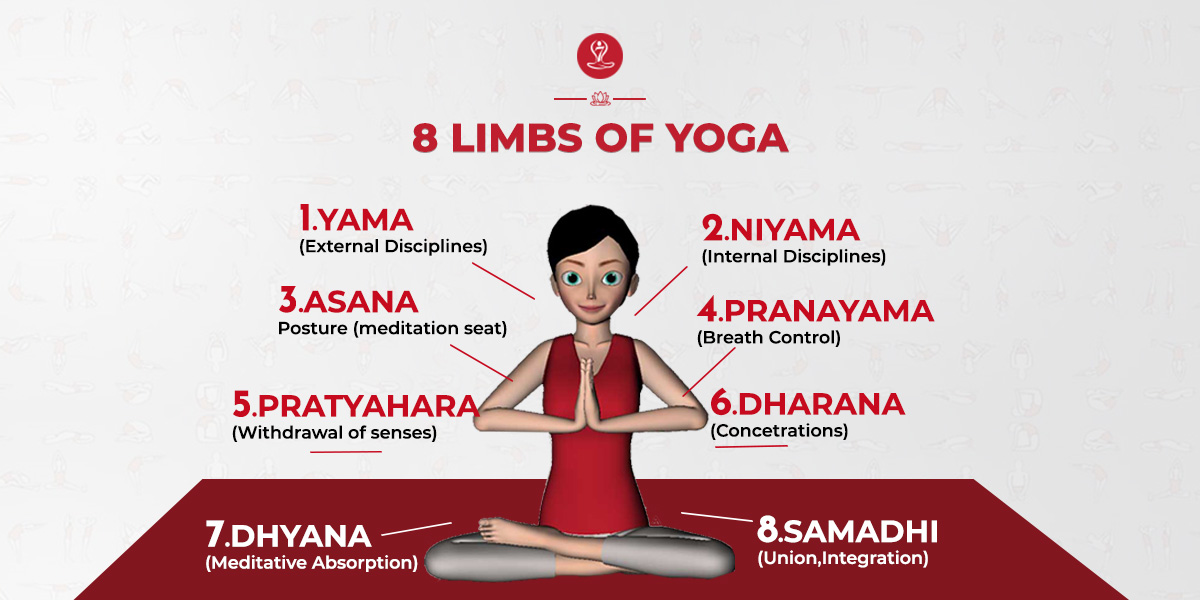
The renowned Yoga Sutras of Patanjali outline the 8 limbs of yoga, each offering profound guidance on living a purposeful and meaningful life. These limbs serve as a roadmap for personal growth, self-discipline, and spiritual development. It is up to each individual to understand these principles and integrate them into daily practice.
The “yoga” word means to connect or unite, or can be called “yoke”. The particular thing we wish to find to connect is the True self, which is also known as “divine essence” or “ultimate self”, and in other words, atman. You might also like to think of this as the human’s soul. If this way of thinking isn’t resonating with your psyche, then consider that the word yoga can also mean disentanglement or separation.
The thing that is disentangling in us is from the things that are stopping us from attaining freedom or the feeling free, as the prime and ultimate goal of yoga is to pave the way to and attain moksha, which means freedom or liberation.
So, how can one attain this moksha or freedom through yoga? Does it mean that a person needs to spend a lot of fortune to attain it? Can one achieve it by simply touching the toes? Well, this is not the case.
As per the Yoga Sutras of Patanjali, there is an eight-fold path that leads to freedom, also known as the “Ashtanga Yoga” System or popularly called the 8 Limbs of Yoga. The word “ashta” means eight in Sanskrit, while “anga” means “limb”.
Now, let’s explore the 8 Limbs of Yoga in detail to give you a complete and holistic understanding of their purpose and characteristics. Each limb carries a unique significance and, when practiced consistently, contributes to a healthier, more balanced, and spiritually aligned life.
8 Limbs of Yoga
1. Yama (Moral Restraints / Ethical Disciplines)
The first limb is Yama, which refers to disciplines, vows, or practices that are primarily concerned with the surroundings and environment around us, along with our interaction with it. While yoga practice can indeed increase physical flexibility and strength as well as aid in calming down the mind, it is of no use if we are still feeling rigid, weak, and completely stressed out in our daily lives.
Five Yamas:
- Aparigraha – Non-possessiveness
- Ahimsa – Non-violence
- Satya – Truthfulness
- Asteya – Non-stealing
- Brahmacharya – Moderation
Yoga is a practice of transformation of our self and benefits every aspect of our lives, not just spending and exercising for 60 minutes on a rubber mat. If we can learn various things, such as to be kind and truthful as well as use our energy in worthy pursuits, we will not only benefit ourselves with these practices but also everyone and everything around us.
2. Niyama (Personal Observances)
The second limb of Yoga is Niyama, which refers to the duties that are directed towards ourselves, but can also be taken into consideration with the actions we take towards the outside world. It comes from the Sanskrit verb “ni” which means “inward” or within.
The Five Niyamas
- Saucha (Cleanliness & Purity): Encourages physical, mental, and emotional cleanliness to create clarity and balance.
- Santosha (Contentment): The practice of accepting and appreciating what we have, leading to inner peace and gratitude.
- Tapas (Discipline / Inner Fire): Represents committed effort, self-control, and the burning enthusiasm that transforms us by burning away impurities or unnecessary desires.
- Svadhyaya (Self-Study & Study of Sacred Texts): Involves reflection, introspection, and gaining insight through personal observation and scriptural learning.
- Ishvarapranidhana (Surrender to a Higher Power): Trusting in a divine force, letting go of ego, and surrendering the fruits of our actions.
Niyama is traditionally and generally practiced by those people who want to travel far along the Yogic path and who intend to build their character. Interestingly, these Niyamas are also closely related to Koshas, the “sheaths or layers” that lead from our physical body to our body’s essence present within. As you will find that when we work with all these Niyamas, we are guided by the grossest aspects of our lives to the deep truth within.
3. Asana (Physical Postures)
The third limb of Yoga is Asana. The physical aspect of yoga is this particular third step on the freedom’s path, and if we are being completely honest about it, the word asana doesn’t only refer the ability to perform a backbend or aesthetically impressive handstand, it means “seat”- specifically the seat that you would take for practicing meditation. The only instruction of alignment that Patanjali gives for this asana is “Sthira Sukham Asanam”, that is the posture or pose should be both steady as well as comfortable.
The word asana comes from the Sanskrit root “ās,” meaning “to sit.”
Purpose of Asana
- Strengthens and purifies the body
- Improves flexibility, balance, and health
- Reduces tension and prepares the nervous system for breathwork and meditation
- Cultivates awareness of the body and mind connection
While various traditional texts, such as Hatha Yoga Pradipika, list different postures like Padmasana or lotus pose and Virasana, the hero pose, well-suited for meditation, this text also reveals that the most essential and important posture is the sthira sukhasan, which means “a posture which a practitioner can easily hold both comfortably and motionless”.
The main notion behind it is the ability to sit in a comfortable position, so we aren’t pulled by pains and aches of the body or any kind of restlessness due to an uncomfortable position. Perhaps this is a thing that needs to be considered when you do yoga next time, if you always tend to go for “advanced” posture offered rather than the one that your body is able to attain. It is not about how many asanas you can do, it is about how many asanas you are really comfortable as well as steady in.
4. Pranayama (Breath Control)
Pranayama is the fourth limb of Yoga. The word Prana means “energy” or the “life source”. These words can be used to signify the essence of life that keeps us alive or the energy in the universe that surrounds us. The Prana is also described as the breath, and by working on the breathing pattern, we can affect and mold our mind in a more realistic way.
The term comes from two Sanskrit words:
- “Prana” – life force or vital energy
- “Ayama” – expansion, control, or extension
Perhaps one of the greatest and fascinating things about this limb of Yoga is the fact that it can essentially mean two completely different things, which lead us to two different directions at one point on the freedom’s path.
Pranayama can also be understood as either “pranayama” that would mean “breath-control” or the “breath-restraint”, or it can also be understood as “pranayama” that would translate to “freedom of breath”, or “breath liberation”.
Types of Pranayama
Some commonly practiced techniques include:
- Nadi Shodhana (Alternate Nostril Breathing)
- Ujjayi (Victorious Breath)
- Kapalabhati (Skull-Shining Breath)
- Bhastrika (Bellows Breath)
- Bhramari (Bee Breath)
Benefits of Pranayama
- Balances the body’s energy flow
- Relaxes the nervous system
- Enhances lung capacity
- Increases mental clarity and concentration
- Reduces stress and anxiety
Each way of breathing will alter the state of our being, and it is all up to us whether we wish to perceive this as “controlling” the way we actually feel or freeing ourselves from the daily routine of our minds working.
5. Pratyahara (Withdrawal of the Senses)
Pratyahara is the fifth limb of Yoga and marks the beginning of the inward journey. The word comes from:
- “Prati” – against or away
- “Ahara” – anything we take in, including sensory inputs
Together, Pratyahara means withdrawal from external distractions and turning awareness inward.
Purpose of Pratyahara
- Bridges external practices (like Asana & Pranayama) with internal ones (Dharana & Dhyana)
- Creates inner quietness
- Helps break automatic reactions to stimuli
- Prepares the mind for deep concentration and meditation
Instead of losing the ability to smell or hear, to feel and see, the practice of pratyahara essentially changes our state of mind such that we become so much absorbed in whatever we are focusing on, that the other things which are outside of ourselves don’t bother us anymore, and we are able to meditate without easily getting distracted by any such outside thing. Experienced practitioners can also translate pratyahara into their daily lives, which means they are so concentrated as well as present to the moment at hand, which makes things like sounds and sensations not distract their mind easily.
6. Dharana (Focused Concentration)
Dharana, the sixth limb of Yoga, means “focused concentration.” The word comes from:
- “Dha” – to hold, maintain, or carry
- “Ana” – other, something else
Together, Dharana refers to holding the mind steadily on one object.
When we have successfully moved on the eightfold yoga path through asana practice, meditation as well as control of the senses, we get ready to go deeper. This is where we start with Dharana, the essential binding of consciousness to one single point.
What We Focus On
Dharana involves fixing the mind on a specific point of concentration. This point can be:
- External: a candle flame, statue, symbol, or any object
- Internal: a chakra, breath, mantra, or body part
Dhaana is quite an important step on our path to the next step, that is Dhyana, or meditation. We have to be able to concentrate our minds before we start to move further. Although the last three steps on the eightfold path of yoga, Dharana, Dhyana, and Samadh, are very much interconnected. These last three steps also represent the internal yoga, the mind’s activities, and they are quite independent of the physical senses. We first will have to achieve the deep concentration of Dharana through which we can further move towards the Dhyana, the meditation, and then finally to Samadhi, the union with the Whole.
7. Dhyana (Meditation / Uninterrupted Flow of Concentration)
Dhyana is the seventh limb of yoga which is built upon asana which is the physical posture, pranayama which is the breath control, pratyahara which is the control of senses with moving of the focus to the inside, and dharna which is concentration. The word Dhyana originates from the Sanskrit word “Dhyai” meaning “to think of.”
From Dharana to Dhyana
- In Dharana, the mind repeatedly brings itself back to the chosen point of focus.
- In Dhyana, the mind flows toward that point without interruption.
- The distinction is subtle but profound: Dharana is effort; Dhyana is ease.
If Dharana is like lighting a lamp, then Dhyana is the steady flame that burns without flickering.
Dhyana involves meditation and concentration on a focus point with the inherent intention of knowing the truth concerning it. This deeper concentration of the mind is itself the instrument of self-knowledge, where a person can easily separate illusion from reality and then eventually reach the ultimate yoga goal, that is Samadhi, bliss, or union with the Whole.
For a regular practitioner, this may sound more like a very high and mighty thing to do. We often practice yoga in order to feel good, to learn a lot about ourselves, and also to find moments of peace during our daily hectic days. Finding the permanent state of bliss may seem a bit out of our league. But do not get discouraged by this. Yoga is a way to show the way and give us the clues along with the guidelines. We can start taking them whichever seems relevant to us.
As per the Yoga Sutra, the main purpose of meditation is to interrupt the normal mental activity’s fluctuations, like sensory knowledge, imagination, and memory. Out of these three, the memory is the one that is the hardest to quieten, and it incessantly feeds us the instances from the past along with an endless stream of feelings and thoughts.
8. Samadhi (Union / Complete Absorption)
Samadhi is the eighth and ultimate limb of Yoga. It represents the state of complete integration, union, and absorption, where the meditator, the act of meditation, and the object of meditation merge into one.
The word Samadhi comes from:
- “Sam” – complete or together
- “A” – toward
- “Dhi” – to focus, to absorb
Together, Samadhi means total integration of awareness or a state of oneness.
What Happens in Samadhi?
In Samadhi:
- The ego (ahaṃkāra) dissolves
- Mental fluctuations stop
- A deep, expansive peace arises
- The separation between self and universe disappears
- One experiences a profound sense of bliss and inner freedom
This is the state in which the practitioner experiences true Yoga, meaning union.
However, there is one thing that one should always keep in mind that the Samadhi isn’t any permanent state. As per Patanjali’s Yoga Sutras dictates importantly, unless we are entirely ready, without any impressions like attachment, desires, aversion, and habits, and with an entirely pure mind, we won’t be able to maintain the Samadhi state for long.
Once the mind becomes pure, and one truly experience the state of Samadhi, one can keep hold of and attain moksha which is also known as Mukti, that means a permanent state of being released, liberated and free.
Types of Samadhi
Classical texts describe levels of Samadhi, including:
- Savikalpa Samadhi – awareness remains, but is deeply still
- Nirvikalpa Samadhi – absolute absorption; beyond thought, form, and identity
Regardless of type, Samadhi is the peak of spiritual realization.
Conclusion
With this, we end our detailed discussion on 8 limbs of yoga. All these limbs explore the various aspects of our body, mind and entire life. You need to get a deeper understanding to know more about getting aligned with the universe and getting associated with it.
You can also read:- 10 Yoga Poses For Beginners | 7 Simple Yoga for Shoulders Pain | Yoga for belly fat | Yoga to increase Height | 7 Yoga Poses for Insomnia | Nadis | 7 Yoga poses for Weight Lifters
RELATED ARTICLES

Jan 30, 2026
The Three Nadis Explained in Simple Words
Prana Breath is the universal vital energy that is literally the thing of life. For all of us who practice[...]

Dec 08, 2025
Jnana Yoga: The Path of True Inner Wisdom
Jnana Yoga is a key part of ancient Hindu philosophy. It teaches that many paths can lead to enlightenment, personal[...]

Jul 17, 2024
Transform Your Life with the 5 Yamas of Yoga
According to Sage Patanjali’s Yoga Sutras, from eight limbs of yoga the first limb of yoga, Yamas (Restraints), refers to[...]
RECENT POSTS


Disclaimer
The content is purely informative and educational in nature and should not be construed as medical advice. Please use the content only in consultation with an appropriate certified medical or healthcare professional