
Realizing the divinity within one’s soul and attaining divine bliss is a spiritual treasure. This path was popularized globally by Paramahansa Yogananda
through the sacred teachings of Kriya Yoga.
In the yogic tradition, life is viewed through four primary dimensions: emotion, intellect, body, and energy. Each dimension has a dedicated path:
- Bhakti Yoga: The path of devotion and emotion.
- Jnana Yoga: The path of intellect and wisdom.
- Karma Yoga: The path of physical action and service.
- Kriya: The path of life energy (Prana).
What is This Ancient Practice?
This ancient meditation technique is designed to bring the life force and breath under conscious control. Often referred to as the “Yoga of Action or Awareness,” it is part of a comprehensive spiritual system that accelerates inner growth and fosters a state of profound peace and union with the Divine.
By utilizing advanced methods of Pranayama and meditation, the practitioner establishes a direct relationship with Truth, leading to self-realization and liberation from worldly bondages.
The Lineage and History
Though its origins are ancient, the technique was revived in 1861 when the immortal saint Mahavatar Babaji taught it to Lahiri Mahasaya. The lineage continued through Swami Sri Yukteswar, who eventually passed the knowledge to Paramahansa Yogananda.
Yogananda later introduced these teachings to the West through his spiritual classic, Autobiography of a Yogi, and established the Self-Realization Fellowship to spread this spiritual science.
How Does Kriya Yoga Work?
The practice is considered highly effective because it works directly with the source of human consciousness: the spiritual energy within the spine.
- Direct Approach: While Hatha Yoga uses yoga poses open spinal passages and traditional breathing makes one aware of energy, this method is more direct.
- Spiritual Evolution: The practitioner mentally directs life energy (Prana) up and down the spine. According to Yogananda, a single “Kriya,” performed with will and awareness, can be equivalent to one year of natural spiritual evolution.
The Five Techniques of Kriya Yoga
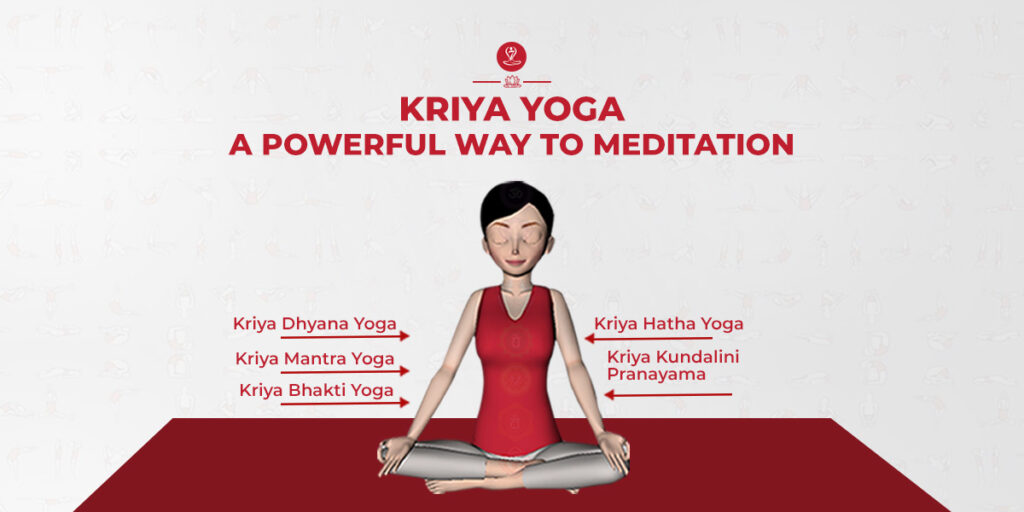
The practice is synthesized into five key branches to ensure a holistic transformation:
- Kriya Hatha Yoga: Focuses on physical postures, Mudras, and Bandhas to strengthen the body and awaken the nervous system.
- Kriya Kundalini Pranayama: Powerful breathing exercises designed to awaken dormant energy and circulate it through the Seven Chakras.
- Kriya Dhyana Yoga: Meditation techniques aimed at purifying the subconscious mind and developing intense concentration and intuition.
- Kriya Mantra Yoga: The silent mental chanting of sacred sounds to calm the mind’s “chatter” and accumulate spiritual energy.
- Kriya Bhakti Yoga: Expressing the soul’s aspiration through worship, service, and devotional activities to cultivate universal love.
Conclusion
Kriya Yoga is more than just a technique; it is a direct path to spiritual enlightenment. By harmonizing physical health, mental clarity, and life energy, it allows a seeker to experience their true nature. As Paramahansa Yogananda famously stated, this practice “works like mathematics; it can never fail.
Frequently Asked Questions about Kriya Yoga
The primary objective is to achieve Self-realization and liberation from worldly suffering. By controlling the breath, practitioners aim to realize their inner divinity and attain constant bliss.
Can anyone practice Kriya Yoga?
While basic philosophy and preparatory exercises (like certain Hatha Yoga
postures) are accessible to most, the advanced techniques usually require initiation. It is recommended to learn from a qualified teacher or an established lineage.
Unlike Hatha, which focuses on the physical body, or Bhakti, which focuses on emotion, this is a direct path working with spinal energy. It is often called the “science of yoga” because it uses specific energetic techniques to accelerate evolution.
Kriya Yoga is a holistic system consisting of:
Kriya Hatha Yoga: Physical postures for health.
Kriya Kundalini Pranayama: Breathing to circulate energy through the Seven Chakras.
Kriya Dhyana Yoga: Meditation for mental purification.
Kriya Mantra Yoga: Sacred sound chanting to calm the mind.
Kriya Bhakti Yoga: Devotional activities to cultivate love.
The spine is viewed as the highway of consciousness. By directing Prana through the spinal column, a practitioner can neutralize karma and “magnetize” the spine, drawing consciousness upward toward higher awareness..
No. It is considered a spiritual science rather than a dogma. It is designed to deepen your existing connection to the Divine, making it compatible with all religious backgrounds.
