
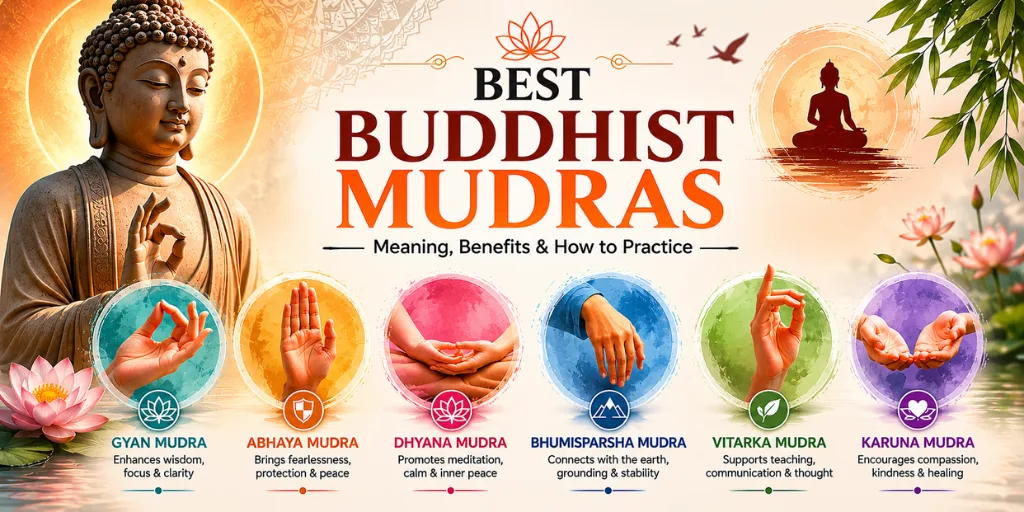
Have you ever noticed how a simple hand gesture can instantly change your mood? In Buddhist and hindu traditions, these gestures are called mudras—sacred hand positions used for centuries to channel chakra energy and focus the mind. Acting like a physical circuit board for your nervous system, shaping your hands helps shape your mindset. Let’s explore 7 Best Buddhist Mudras .
1. Dhyana Mudra — The Gesture of Meditation
Dhyana means meditation, absorption, or deep contemplative stillness. This mudra is perhaps the most universally recognized of all Buddhist hand gestures — it is the position in which the Buddha is most commonly depicted in meditation.

To form it, place both hands in the lap with palms facing upward. Rest the right hand on top of the left, with the tips of the thumbs lightly touching to form an oval. The hands rest in the lap like a bowl — open, receptive, holding nothing and rejecting nothing.
This mudra appears at one of the most pivotal moments in the Buddha’s life — his meditation under the Bodhi tree on the night of his awakening. It is the gesture of complete inner withdrawal, of turning attention fully inward, of resting in the spacious awareness that underlies all experience.
For the practitioner, holding Dhyana mudra during meditation creates a natural stillness in the hands that communicates directly to the mind. The oval formed by the thumbs is sometimes described as representing the flame of inner awareness — protected within the bowl of the hands, neither forced nor extinguished.
Quality invoked: Deep meditative stillness, inner receptivity, awareness resting in itself.
2. Bhumisparsha Mudra — The Earth-Touching Gesture
Bhumisparsha means “touching the earth.” This mudra depicts one of the most dramatic and significant moments in the entire Buddhist tradition — the moment the Buddha called the earth itself to witness his awakening.
On the night of his enlightenment, as the demon Mara challenged his right to awaken, the Buddha reached his right hand down from his meditation posture and touched the ground with his fingertips. The earth responded — trembling in recognition, bearing witness to countless lifetimes of the Bodhisattva’s practice and compassion.
To form it, sit with the left hand resting palm upward in the lap. Extend the right hand over the right knee, fingers pointing downward, fingertips lightly grazing or pointing toward the earth. The gesture is one of rooting — of calling on the ground of reality itself as witness.
This mudra represents unshakeable stability, the confidence of one who has done the inner work and is not intimidated by doubt — inner or outer. It is also a gesture of profound humility: it is not the ego declaring victory, but awareness touching its own ground.
Quality invoked: Unshakeable groundedness, fearlessness in the face of doubt, the stability of awakening.
3. Abhaya Mudra — The Gesture of Fearlessness
Abhaya means fearlessness, protection, and the granting of safety. This mudra is among the oldest in the Buddhist tradition, appearing in some of the earliest stone sculptures of the Buddha and remaining one of the most beloved across all Buddhist cultures.
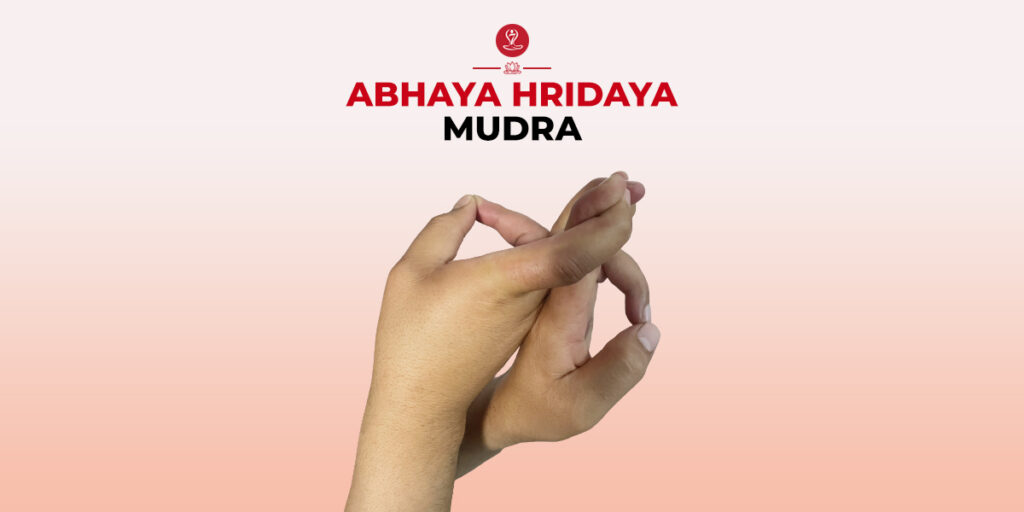
To form it, raise the right hand to shoulder height with the elbow bent, palm facing outward, fingers pointing upward and held together. The left hand rests naturally at the side or in the lap. In some traditions, both hands are raised simultaneously.
The gesture is immediately recognizable — it is the universal human gesture for “stop” or “peace.” The Buddha is said to have used this mudra when stopping a rampaging elephant sent to harm him, calming the animal through the pure force of compassion and fearlessness that radiated from his presence.
For the practitioner, Abhaya mudra is both a giving and a receiving. It offers the qualities of protection and safety outward — and it also cultivates them inward. Holding this mudra with genuine presence gradually strengthens the quality of fearlessness in the one who holds it.
Quality invoked: Fearlessness, protection, the granting of refuge, inner courage.
4. Varada Mudra — The Gesture of Giving
Varada means gift, boon, or the act of granting. This is the mudra of generosity — the open hand extended downward in an act of giving, offering, and bestowing.
To form it, extend the right arm downward with the palm facing outward and upward, fingers pointing toward the ground, as if offering something to one who stands before you. The gesture suggests both an open hand — nothing hidden, nothing withheld — and a downward flow, as if grace or blessing is flowing from the higher to the lower.
Varada mudra represents dana — the foundational Buddhist virtue of generosity. But it goes beyond the giving of material things. It is the gesture of one who gives fearlessness, gives wisdom, gives the teachings, gives attention and compassion without reservation. Many Bodhisattva figures in Buddhist art are depicted with Varada mudra — representing their vow to benefit all beings without exception.
In practice, holding this mudra cultivates the spirit of open-handed giving. It works directly against the grasping quality of the mind — the tendency to hold on, to accumulate, to protect what is “mine.” The open, downward-facing palm is the antithesis of the clenched fist.
Quality invoked: Generosity, open-hearted giving, the flowing of compassion and grace toward all beings.
5. Dharmachakra Mudra — The Gesture of Teaching
Dharmachakra means “wheel of the Dharma.” This mudra represents the moment the Buddha gave his very first teaching — his first turning of the wheel of Dharma — at the Deer Park in Sarnath, shortly after his awakening, to the five ascetics who had once been his companions.
To form it, bring both hands in front of the heart center. The left hand faces inward toward the body, the right hand faces outward. The thumbs and index fingers of each hand touch to form circles, with the remaining fingers extended. The hands are brought close together so that the middle finger of the right hand touches — or nearly touches — the circle formed by the left hand’s thumb and index finger.
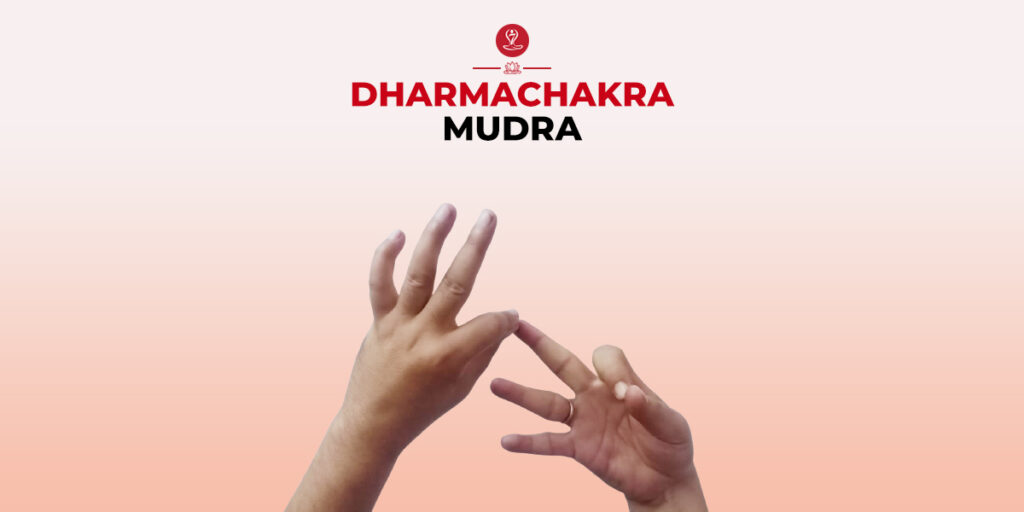
This mudra is among the most geometrically precise and energetically concentrated of all Buddhist hand gestures. The two circles represent the wheel of Dharma being set in motion. The heart center placement indicates that the teaching flows from the direct experience of awakening, not from intellectual understanding alone.
Quality invoked: The transmission of wisdom, the setting of the Dharma wheel in motion, the act of teaching from direct realization.
6. Vitarka Mudra — The Gesture of Discussion and Transmission
Vitarka means reasoning, discussion, or the transmission of teaching. This mudra is closely related to Dharmachakra mudra but carries a slightly different energy — it is less the formal turning of the wheel and more the intimate gesture of a teacher sharing wisdom directly with a student.

To form it, raise the right hand to chest or shoulder height with the palm facing outward. Bring the tip of the thumb and the tip of the index finger together to form a circle, while the remaining three fingers extend upward, relaxed but straight. In some traditions, the left hand mirrors this gesture or rests in Varada mudra.
The circle formed by the thumb and index finger is central to the meaning. It represents the perfection of the teaching — complete, without beginning or end. It also represents the Dharma wheel in miniature. The three extended fingers are sometimes associated with the Three Jewels: the Buddha, the Dharma, and the Sangha.
This mudra appears frequently in depictions of the Buddha engaged in conversation and transmission. It is the gesture of direct pointing — not explaining around the truth but pointing straight at it.
Quality invoked: Wisdom transmission, direct pointing to truth, the intimacy of teacher-student exchange.
7. Anjali Mudra — The Gesture of Reverence and Prayer
Anjali comes from the Sanskrit root meaning “to offer” or “to salute with reverence.” While this mudra is not exclusively Buddhist — it appears throughout Hindu, Jain, and general Indian spiritual culture — it holds a central and beautiful place in Buddhist practice and is perhaps the most universally practiced mudra of all.

To form it, bring both palms together at the heart center, fingers pointing upward, with a small hollow space between the palms as if holding something precious and fragile. The thumbs rest lightly against the sternum. This is the gesture known across the world as “Namaste” in the Hindu tradition and “Gassho” in Japanese Zen Buddhism.
In Zen, Gassho is not merely a greeting. It is a complete practice in itself. To bring the palms together is to bring duality together — right and left, self and other, student and Buddha. The hollow at the center of the gesture represents the space of awakening — empty, open, and infinitely receptive.
This mudra is used at the beginning and end of meditation, in prostrations, in the chanting of sutras, and whenever the practitioner wishes to acknowledge the sacred — in a teacher, in the Three Jewels, in another person, or in the moment itself.
Quality invoked: Reverence, devotion, the recognition of the sacred in all things, the unity of apparent opposites.
How to Practice Buddhist Mudras
Mudras are most powerful when held with full attention and sincere intention — not merely as physical positions but as inner stances that the body is giving form to.
Begin by choosing one mudra to work with. Sit comfortably in your usual meditation posture. Take a few deep, slow breaths to settle the body and mind. Then bring the hands into the chosen mudra — slowly, deliberately, with attention.
Once the hands are in position, hold them there without strain. Notice the subtle physical sensations that arise — warmth, tingling, a sense of energy moving. Notice the quality of mind that the mudra seems to support. If you are holding Dhyana mudra, notice how the stillness of the hands seems to invite a corresponding stillness in the mind. If you are holding Abhaya mudra, notice whether a quality of steadiness or courage begins to arise.
Hold the mudra for the duration of your meditation — typically between ten and forty minutes. Over time, with consistent practice, the association between the mudra and its corresponding inner quality deepens. The mudra becomes a key — and the mind learns to open the door more and more readily each time the key is used.
Frequently Asked Questions
Yes. Mudras work through the body and the nervous system — their effects are not dependent on holding any particular belief. Many people practice them as part of general meditation without any religious affiliation and receive genuine benefit.
Both are valid. Mudras are most traditionally used during seated meditation, but they can also be held briefly during moments of stress, before an important conversation, or anytime you wish to invoke a specific quality of mind.
Traditionally, mudras are held for the duration of a meditation session — anywhere from ten minutes to an hour or more. Even holding a mudra for five minutes with full attention will produce a noticeable effect. Consistency over time matters more than duration in any single session.
While many mudras appear in both traditions and share the same Indian cultural roots, their specific meanings and applications often differ. Hindu mudras — particularly in the Tantric tradition — tend to work more directly with prana and the energy body. Buddhist mudras tend to emphasize the expression and cultivation of specific states of mind and qualities of consciousness. In practice, the overlap is considerable.
Yes, though they are most powerful in combination with meditation. Simply holding a mudra while sitting quietly, breathing consciously, and holding the intention associated with the gesture is a complete practice in itself.
Conclusion
Buddhist mudras are among the most elegant transmissions the contemplative tradition has ever produced. In a gesture as simple as placing the hands in the lap or raising a palm toward the world, centuries of wisdom are compressed into a form the body can hold and the mind can follow.
Each of the seven mudras explored here — Dhyana, Bhumisparsha, Abhaya, Varada, Dharmachakra, Vitarka, and Anjali — is a doorway. Not a doorway to somewhere else, but a doorway inward, to qualities that are already present in you: stillness, groundedness, fearlessness, generosity, wisdom, and reverence.
The hands know things the thinking mind has forgotten. Let them remember.
