
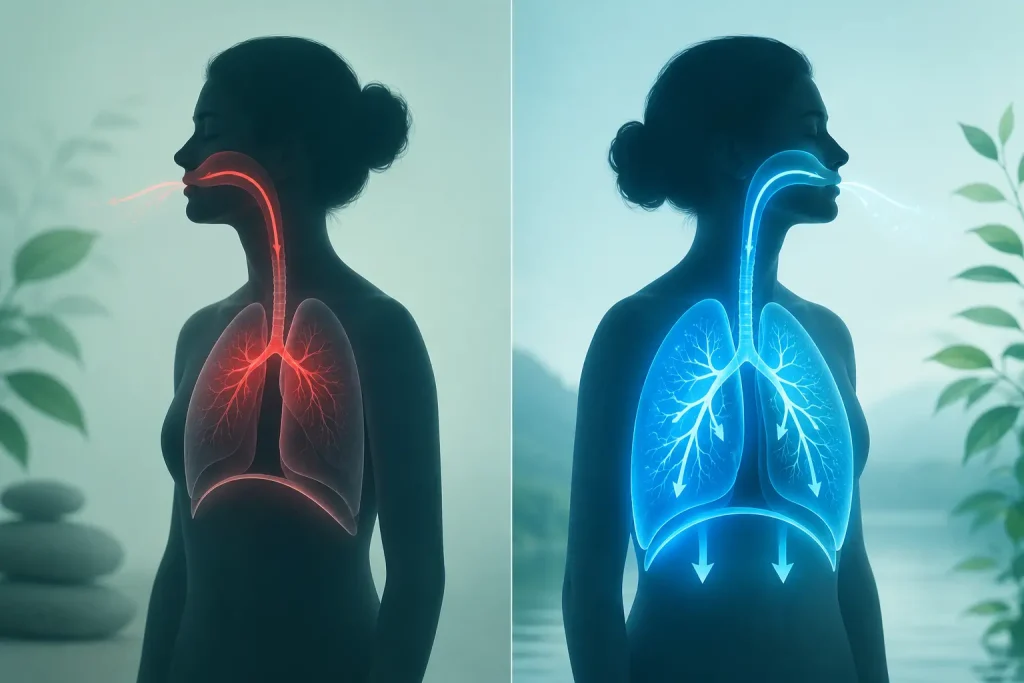
Shallow breathing vs deep breathing is a common comparison when discussing respiratory health and overall wellness. Shallow breathing is a breathing pattern in which a person takes short, quick breaths and inhales less oxygen. Deep breathing, on the other hand, is a technique where a person takes slow, full breaths that allow more oxygen to enter the body. Deep breathing is generally considered healthier because it helps relax the mind, improves oxygen flow, and supports overall well-being.
In this article, let us understand shallow breathing vs deep breathing, which one is better, the causes of shallow breathing, the benefits of deep breathing, and how you can practice deep breathing correctly in daily life.
The Golden Rule: Shallow breathing is a reaction to your environment; deep breathing is a conscious choice to lead your environment.
Below is Shallow Breathing vs Deep Breathing Tabular Comparison
| Aspect | Shallow Breathing | Deep Breathing |
|---|---|---|
| Definition | Short, quick breaths using the chest | Slow, full breaths using the diaphragm |
| Breathing Area | Mostly upper chest | Belly and lower lungs expand |
| Oxygen Intake | Lower oxygen supply | Higher oxygen supply |
| Carbon Dioxide Removal | Less efficient | More efficient |
| Heart Rate | Can increase heart rate | Helps slow heart rate |
| Stress Impact | Often linked to stress and anxiety | Promotes relaxation and calmness |
| Energy Levels | May cause fatigue or dizziness | Improves energy and focus |
| Muscle Tension | Can increase tension | Helps relax muscles |
| Lung Capacity | Uses only a small part of lungs | Uses full lung capacity |
| Sleep Quality | May disturb sleep | Supports better sleep |
| Common Causes | Stress, poor posture, anxiety | Meditation, yoga, pranayama |
| Health Benefits | Minimal long-term benefits | Better mental and physical health |
| Example | Rapid breathing during panic | Slow breathing during yoga practice |
Deep Dive: Why Your Body Craves Deep Breaths
While the table gives a great overview, your readers will appreciate knowing the “hidden” benefits.
- The Vagus Nerve Connection: Shallow breathing keeps you in a state of “High Alert.” Deep breathing acts like a physical “off switch” for stress by stimulating the Vagus Nerve.
- The Posture Loop: Did you know your posture and breath are best friends? Slouching forces you to breathe shallowly, which makes you feel tired, which makes you slouch more. Breaking the cycle starts with one deep breath.
🧘 How to Practice: The “Hand-on-Heart” Check
Give your readers a simple way to test themselves right now:
- Place one hand on your chest and the other on your belly.
- Breathe naturally. Which hand moves more?
- The Goal: If the top hand moves, you’re “chest breathing.” Try to send the air down so only the bottom hand moves. It’s like filling a glass of water—the bottom fills up first!
How Pranayama Trains You for Deep Breathing
Deep breathing is the foundation, but Pranayama is the practice that masters it. While deep breathing is often a passive relaxation tool, Pranayama (the yogic science of breath control) is an active workout for your respiratory system.
If you find deep breathing difficult, these three Pranayama techniques are the best place to start:
1. Diaphragmatic Breathing (Adham Pranayama)
This is the “Level 1” of deep breathing. It teaches you to stop using your chest and start using your diaphragm.
- How to do it: Lie on your back. As you inhale, feel your belly rise like a mountain. As you exhale, let it sink back down.
- The Benefit: It strengthens the diaphragm muscle, making deep breathing feel effortless over time.
2. Alternate Nostril Breathing (Nadi Shodhna)
This technique focuses on balance and slowing down the breath rhythm.
- How to do it: Use your thumb to close your right nostril, inhale through the left. Close the left, exhale through the right. Repeat on the other side.
- The Benefit: It balances the nervous system and instantly lowers the “panic” associated with shallow breathing.
3. Humming Bee Breath (Bhramari Pranayama)
A fantastic tool for those who struggle with racing thoughts while trying to breathe deeply.
- How to do it: Take a deep breath in, and as you exhale, make a steady, low-pitched humming sound like a bee.
- The Benefit: The vibration naturally lengthens your exhalation, forcing your body into a deep, restorative state.
💡 Pro Tip for 7pranayama Users
Don’t try to master these all at once. Start with 5 minutes of Diaphragmatic Breathing every morning. Once your body remembers how to use the belly instead of the chest, deep breathing will become your “default” setting, even when you aren’t thinking about it.
Take Action: You can find guided timers and step-by-step instructions for all these techniques right inside the 7pranayama app. Consistency is the key to moving from a shallow breather to a deep, mindful breather!
🏁 Conclusion: Taking Control of Your Breath
In the battle of shallow breathing vs deep breathing, the winner is clear. While shallow breathing (or chest breathing) is a natural response to a stressful environment, it shouldn’t be your default state. By consciously choosing deep breathing, you are actively training your body to move from a state of “fight or flight” into the parasympathetic nervous system—the zone where true healing and recovery happen.
Remember, your breath is the bridge between your mind and your body. Whether you are using nose breathing vs mouth breathing (another essential topic for respiratory health!) or practicing your daily Pranayama, every deep breath is a step toward a calmer, more energized you.
FAQ
Not necessarily. Shallow breathing is useful during short bursts of intense physical activity. However, if it becomes a chronic habit, it can lead to reduced lung capacity, increased anxiety, and physical fatigue.
Deep breathing is similar to yoga exercise—the more regularly you practice, the stronger the long-term benefits become. Even one session can help, but lasting improvements usually require consistent practice over several weeks.
This is common! If you are used to shallow breaths, a sudden intake of high oxygen can feel a bit strange. If this happens, slow down your pace and ensure you are exhaling fully to balance your carbon dioxide levels.
Absolutely. Techniques like Adham Pranayama specifically retrain your diaphragm. Over time, these practices increase your oxygen intake and make deep breathing feel like second nature.
