

Quick Answer: Not all fruits are equal when it comes to weight loss. Fruits high in natural sugar, glycemic index, and calories — like mangoes, grapes, and bananas — can quietly stall your progress if eaten in excess. Knowing which fruits to limit, and when, makes a significant difference on a weight loss journey.
Table of Contents
- Why Some Fruits Can Slow Weight Loss
- Fruits to Avoid or Limit for Weight Loss
- How Much Fruit Is Too Much?
- Best Fruits to Eat for Weight Loss
- The Right Time to Eat Fruit
- Common Mistakes People Make with Fruit
- FAQs
Why Some Fruits Can Slow Weight Loss
Fruit has a health halo — and in many ways, it deserves it. Fruits are packed with vitamins, minerals, antioxidants, and fiber. But there is one thing that often gets overlooked in the conversation: fruit contains sugar. Natural sugar, yes — fructose, not the refined white sugar in a candy bar — but sugar nonetheless.
And here is what matters for weight loss: your liver processes fructose differently from glucose. When consumed in excess, fructose is converted into fat in the liver rather than being used directly for energy. This is why eating three mangoes a day and calling it “clean eating” is not the same as eating a bowl of leafy greens.
The other factor is the glycemic index — a measure of how quickly a food raises blood sugar. High-glycemic fruits cause a rapid spike in blood sugar, followed by an equally rapid crash that leaves you hungry, craving more sugar, and reaching for another snack. For someone trying to lose weight, this cycle is one of the most common hidden obstacles.
This does not mean fruit is bad. It means that fruit — like everything — requires context, portion awareness, and a little wisdom about which ones serve your goal and which ones quietly work against it.
Fruits to Avoid or Limit for Weight Loss
Mango
Mango is one of the most beloved fruits in the world — and one of the most calorie-dense. A single medium mango contains approximately 200 calories and 45 grams of sugar. It also sits relatively high on the glycemic index, meaning it raises blood sugar quickly.
This does not mean mango is unhealthy. It is rich in Vitamin C, Vitamin A, and digestive enzymes. But for someone in a calorie deficit trying to lose weight, eating mango freely — especially in summer when it is abundantly available — can quietly push daily calorie intake well above the target.
If you love mango, do not eliminate it. Limit yourself to a small portion — about half a cup — and pair it with a protein source to slow the sugar absorption.
Grapes
Grapes are small, sweet, and dangerously easy to overconsume. A single cup of grapes contains around 100 calories and 23 grams of sugar — and most people eat two or three cups without noticing. They have very little fiber relative to their sugar content, which means they do not fill you up the way a fiber-rich fruit would.
Grapes also have a relatively high glycemic load. They are essentially nature’s candy — enjoyable in moderation, but easy to overdo.
Bananas (Ripe)
Bananas are a complicated case. An unripe or slightly green banana is actually a reasonable choice — it contains more resistant starch, which feeds gut bacteria and does not spike blood sugar significantly. But a fully ripe, sweet, soft banana is a different story — it has a higher glycemic index and more available sugar.
Bananas are also calorie-dense for their size. One large ripe banana can contain 120 to 135 calories. For someone who eats two bananas as a “light snack,” that is 250 calories of mostly sugar with moderate fiber — not the most efficient use of a snack opportunity on a weight loss plan.
Chikoo (Sapodilla)
Chikoo is one of the most underrated culprits in the Indian weight loss conversation. It is dense, very sweet, and contains around 83 calories per 100 grams — more than most common fruits. Its glycemic index is high, and it is very easy to eat two or three at once because they are small and taste like caramel.
If you are tracking calories and struggling to understand why the scale is not moving, chikoo may be worth examining.
Litchi
Litchi is another high-sugar fruit that is easy to eat in large quantities. It is refreshing, light-tasting, and naturally portion-distorting — you eat ten before you realize you have eaten ten. A cup of litchi contains around 125 calories and 29 grams of sugar with minimal fiber.
It also has a relatively high glycemic index, making it one of the fruits that works against the steady blood sugar levels that support fat burning.
Dried Fruits — Dates, Raisins, Figs
Dried fruits deserve their own category because they are often marketed as health foods — and they do contain nutrients — but they are essentially concentrated sugar with the water removed. A single date contains about 20 grams of sugar. A small box of raisins contains more sugar than many chocolate bars.
The fiber is still present, which is better than refined sugar, but the caloric density of dried fruits is among the highest of any natural food. A handful of raisins that takes ten seconds to eat contains 130 calories — the same as a large apple that would take several minutes to eat and would leave you far more satisfied.
Avocado (In Excess)
Avocado sits in an unusual position — it is low in sugar, which is excellent, but it is extremely calorie-dense due to its fat content. Half an avocado contains approximately 120 calories. This fat is healthy — it is predominantly oleic acid, the same monounsaturated fat found in olive oil — but calories from healthy fat still count.
For weight loss, avocado is not something to avoid but something to measure. Half an avocado as part of a meal is beneficial. Half an avocado at every meal plus avocado toast for breakfast is a calorie surplus wearing a wellness costume.
Also Read: Foods You Should Never Eat at Night — some of the worst nighttime choices are surprisingly marketed as healthy options.
How Much Fruit Is Too Much?
Most nutrition guidelines suggest two to three servings of fruit per day as a reasonable upper limit for someone trying to lose weight — with one serving being roughly a medium-sized fruit or one cup of cut fruit.
The more important variable is not just quantity but timing and pairing. Eating fruit alone as a standalone snack results in a faster blood sugar spike than eating fruit as part of a meal that contains protein, fat, and fiber. Adding a handful of nuts to your fruit snack, or eating fruit after a protein-rich meal, significantly moderates the glycemic response.
The other variable is individuality. Some people are more insulin-sensitive than others. For someone with insulin resistance, pre-diabetes, or PCOS, even moderate fruit consumption may require more careful management. Paying attention to how your body responds — energy levels after eating, hunger patterns, and the pace of weight loss — is more valuable than any generic guideline.
Best Fruits to Eat for Weight Loss
Not all fruit needs to be limited. Several fruits are genuinely supportive of weight loss — they are high in fiber, low in sugar, and have a low glycemic index that keeps blood sugar steady and hunger at bay.
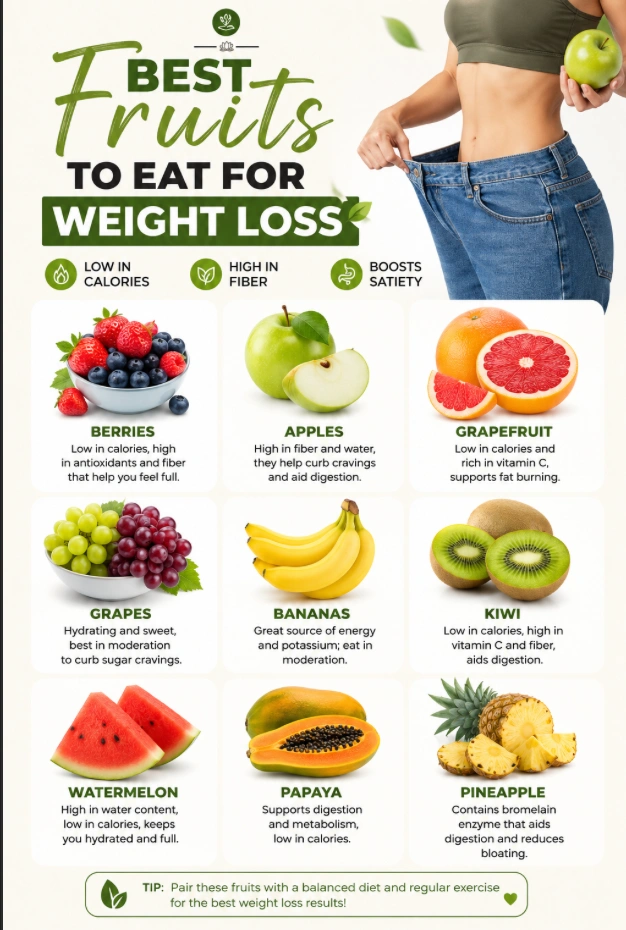
Berries — strawberries, blueberries, raspberries, and blackberries — are among the best fruits for weight loss. They are low in calories, high in fiber, high in antioxidants, and have a very low glycemic index. A full cup of strawberries contains only about 50 calories.
Papaya is an excellent choice for weight loss in the Indian context. It is low in calories, high in fiber, and contains the enzyme papain which supports digestion and reduces bloating. It is also filling — a generous bowl of papaya is very satisfying for very few calories.
Watermelon is mostly water, which makes it naturally low in calories and very hydrating. A large bowl of watermelon contains surprisingly few calories. Its high water content also creates a feeling of fullness. While it has a high glycemic index, its glycemic load — which accounts for how much carbohydrate is actually in a typical serving — is quite low.
Guava is a particularly undervalued fruit for weight loss. It is high in fiber, relatively low in sugar, and extremely rich in Vitamin C. It keeps you full for longer and has a moderate glycemic index.
Apple lives up to its reputation. High in pectin — a soluble fiber that forms a gel in the digestive tract and slows sugar absorption — apples are genuinely filling and blood-sugar-friendly. Eating an apple before a meal has been shown in studies to reduce overall calorie intake at that meal.
The Right Time to Eat Fruit
When you eat fruit matters as much as which fruit you eat.
The best time to eat fruit is in the morning or early afternoon — when your metabolism is more active, your insulin sensitivity is higher, and your body is better positioned to use the natural sugars for energy rather than storing them.
Eating fruit before a workout is an excellent strategy — the natural sugars provide readily available energy without the crash that comes from refined carbohydrates.
The worst time to eat fruit is late at night. After sunset, your metabolism slows, insulin sensitivity decreases, and your body is preparing to rest rather than burn fuel. Eating high-sugar fruits at night significantly increases the likelihood that the sugar will be stored as fat rather than used as energy.
Also Read: Why What You Eat at Night Determines Your Weight — the nighttime eating pattern is one of the most underestimated factors in weight management.
Common Mistakes People Make with Fruit
Drinking fruit juice instead of eating whole fruit. Juice removes most of the fiber, concentrates the sugar, and eliminates the chewing and volume that contribute to satiety. A glass of orange juice contains the sugar of four to five oranges with almost none of the fiber. Always eat the whole fruit.
Calling a fruit smoothie a light meal. A smoothie made with two bananas, a cup of mango, and a cup of grapes can easily contain 400 to 500 calories and 80 grams of sugar — more than a full meal. Blending also breaks down the fiber structure, making the sugar absorb faster.
Eating unlimited fruit because it is “natural.” Natural does not mean calorie-free. The body does not distinguish between natural fructose and any other caloric source when you are in a surplus.
Ignoring dried fruits. As mentioned above, dried fruits are caloric landmines hiding behind a health food identity. Dates in your morning oats, raisins in your trail mix, and figs in your evening snack add up to a significant calorie load that most people do not account for.
Frequently Asked Questions
Is it okay to eat fruit every day when trying to lose weight? Yes — fruit every day is absolutely fine. The key is choosing the right fruits, eating appropriate portions, timing your intake wisely, and being aware of total daily calorie and sugar intake. Two to three servings of low-to-moderate glycemic fruit per day is a sensible guideline for most people.
Can eating too much fruit cause weight gain? Yes, it can — if it pushes your total calorie intake above your expenditure. This is rare if you are eating whole fruits in reasonable quantities, but very possible if you are eating large amounts of high-calorie fruits like mango and chikoo, or consuming fruit in juice and smoothie form.
Is banana good or bad for weight loss? It depends on ripeness, portion, and context. A small, slightly underripe banana eaten as part of a balanced meal is a reasonable choice. A large, fully ripe banana eaten alone as a daily snack multiple times a day is less ideal for weight loss.
Which fruit is best to eat in the morning for weight loss? Papaya, apple, guava, and berries are excellent morning choices. They are high in fiber, moderate in sugar, and support a stable blood sugar level through the morning — which reduces mid-morning cravings.
Should I avoid fruit at night completely? Not necessarily avoid, but definitely limit and choose carefully. If you want fruit in the evening, opt for low-sugar options like a small bowl of berries or a slice of papaya rather than high-sugar fruits like mango, grapes, or bananas.
Is fruit sugar the same as added sugar? No — fruit sugar (fructose) comes packaged with fiber, water, vitamins, and minerals that slow its absorption and provide genuine nutritional benefit. Added sugar in processed foods provides none of these. However, in very large quantities, fructose from fruit can still contribute to fat storage, which is why portion awareness matters even with natural sugars.
Conclusion
Fruit is not the enemy of weight loss — but the idea that all fruit is equally beneficial, and that you can eat unlimited amounts of any fruit without consequence, is a myth worth letting go of. The fruits explored in this article — mango, grapes, ripe bananas, chikoo, litchi, dried fruits, and excess avocado — are not bad foods. They are simply foods that require more awareness and moderation when weight loss is the goal.
Eat your fruit whole, eat it at the right time, choose fiber-rich and lower-sugar varieties as your primary options, and pair it with protein or fat when possible. Small, consistent adjustments in how you approach fruit can make a meaningful difference in how your body responds — without asking you to give up one of life’s simple pleasures.
Also Read: Yoga for Weight Loss — the conversation about weight loss does not end with what you eat during the day. What you exercise also matters.
