
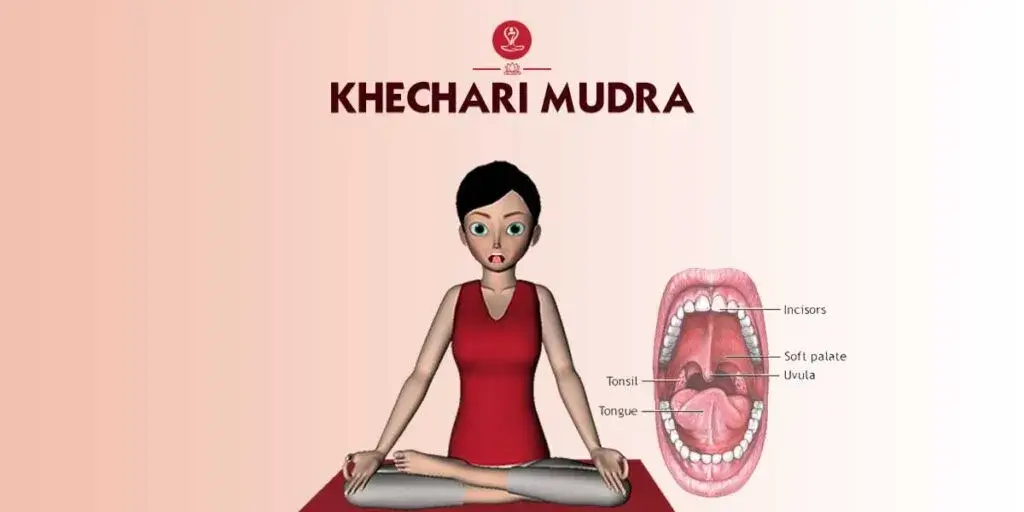
Khechari Mudra is a pose of Yogasadhana. In this posture, both the mind and the tongue are concentrated towards the sky, due to which it is named ‘Khechri’.
The “Khechari Mudra” has been referred to in Yoga as ‘Mother of Yogis‘. Khechari Mudra has considered the king in Mudras. Khechari mudra is an advanced practice that helps a yogi to reach higher levels of consciousness.
The main benefits of Khechari Mudra awaken the Kundalini power within the body. Through this mudra, it helps to prove Pranayama and to establish samadhi. By performing this mudra, one gets relief from mental and physical diseases. Khechari Mudra is known for victory in death ie longevity.
Khechari Mudra (tongue lock) Meaning
Khechari= Khe+chari
Khe= space and Chari= to move
Mudra= Gesture or posture
Khechari mudra is also very important to bring a rapid pace in meditation. ‘Khechari’ means… .. Khe = sky, Chari = variance. That is the variance in the sky element i.e. gesture of moving freely in the infinite space of Brahman.
It is said that those who prove Khechari Mudra get the pleasure of secreting nectar.
How To Do Khechari Mudra (tongue lock)
- First of all, sit in any comfortable seating posture and place the hands with palms pointing upwards on the thighs or the knees.
- Meditation postures like Padmasana, Siddhasana, Swastikasana, Vajrasana, etc. are ideal for the practice of mudras.
- Close your eyes and take some deep breaths with the awareness of the breathing process.
- Now fix your gaze on the center space between eyes i.e. Third eye chakra.
Stage 1.
- To begin Khechari mudra, fold your tongue and try to move it from the top surface of the mouth to the back. See how far back it can go. Initially, the tongue can barely reach the hard palate.
- Initially, anyone may be able to keep it for less than a minute. When there is pain in the tongue, release the tongue and bring it back to normal. If you have pain while doing it, bring it back down
- Do this 3-4 times until your tongue rests on the soft palate.
- As you continue to practice, your tongue will touch the uvula and then touch the nerve connected to the head. If you can’t do it in simple ways, you can push the back of the tongue with your finger.
- The above process should be continued and the tongue will be able to touch the uvula for a long time.
- On completion of this action, when the tongue becomes so long that it reaches the head, your posture will be proved.
Stage 2.
- With further practice, it is now Uvula’s turn to find a place behind him and be able to go after him. Whence the tongue does not return to its previous position.
- This further tongue enters the nasal cavity.
- When your tongue moves inwards, it stops the ADA-Pingala and Sushumna pulse.
- A liquid is produced from the constant churning of the tongue. Initially, it may be salty which has to spit out. Later the juice becomes sweet. In Hatha Yoga, this saliva is called Amritpan (nectar).
- There is a special kind of spiritual experience while secreting this nectar. This experience leads to rapid progress in sainthood and samadhi.
- Rest for some time and try again.
This yoga is very difficult. But care should be taken not to rush into it. It may take from 10 months to 12 months to keep practicing this. It depends on the competence and dedication of the person who is doing this pose. Do not do this activity with your mind, it is good to do it under the supervision of a good Yoga teacher.
Benefits of Khechari Mudra (Nabho Mudra)
- Khechari Mudra is an advanced practice that can bring positive changes in body and mind (physical and spiritual).
- This makes a person’s immune system very strong and the body becomes divine.
- It stimulates the pituitary gland and also balances the secretion of the thyroid gland.
- This posture controls anxiety and stress levels and relieves insomnia etc.
- Also slows heart rate, and increases metabolic activity.
- This mudra brings a profound sense of calmness and peace.
- With regular practice of this mudra, a balance in overall health can be achieved.
- Khechari Mudra is said to the awakening the kundalini. This energy is guided upwards towards the Ajna Chakra (Third Eye).
- With regular practice of this mudra, the seeker gets control of his breath.
- It is believed that by doing this action, a beautiful body is obtained and the body does not grow old too.
Precautions
Khechari mudra can be potentially dangerous if not done correctly. Rolling the tongue too far back or trying to force it into position can cause injury to the tongue, throat, or palate. Therefore, it is recommended that one should learn this practice under the guidance of a qualified teacher who can provide proper instruction and ensure that the practitioner is ready for this advanced practice.
Conclusion
Khechari mudra is considered an advanced practice and may not be suitable for everyone. It is recommended that one should approach this practice with humility and awareness of one’s own limitations and capacities. It is also important to consult with a healthcare professional before attempting any new yoga or meditation practice.
FAQ
Khechari Mudra is an advanced yogic gesture in which the tongue is gently placed against or behind the upper palate during meditation. It is traditionally practiced to improve concentration, mindfulness, and spiritual awareness.
Beginners should sit comfortably with a straight spine, close their eyes, breathe slowly, and gently place the tongue against the upper palate without forcing it. Practice for 3–5 minutes daily and gradually increase the duration.
Yes. Daily practice is generally recommended for beginners when performed gently and without discomfort. Consistency is more important than practicing for long periods.
The best time is early morning during meditation or pranayama on an empty stomach. It can also be practiced in the evening when the mind is calm.
People with tongue injuries, mouth infections, recent dental surgery, or severe oral discomfort should avoid this mudra until fully recovered. If you have any medical concerns, consult a healthcare professional or qualified yoga instructor.
Yes. Khechari Mudra is traditionally believed to deepen meditation by encouraging mental stillness, improving focus, and supporting mindful breathing.
When practiced correctly, Khechari Mudra is generally safe. However, forcing the tongue into advanced positions may cause pain or injury. Beginners should always progress gradually.
Start with 3–5 minutes daily and slowly increase the duration as your comfort and experience improve. Advanced practitioners may practice for longer under proper guidance.
Many practitioners report feeling calmer and more relaxed after practicing Khechari Mudra, which may support better sleep quality when combined with meditation and healthy lifestyle habits.
