
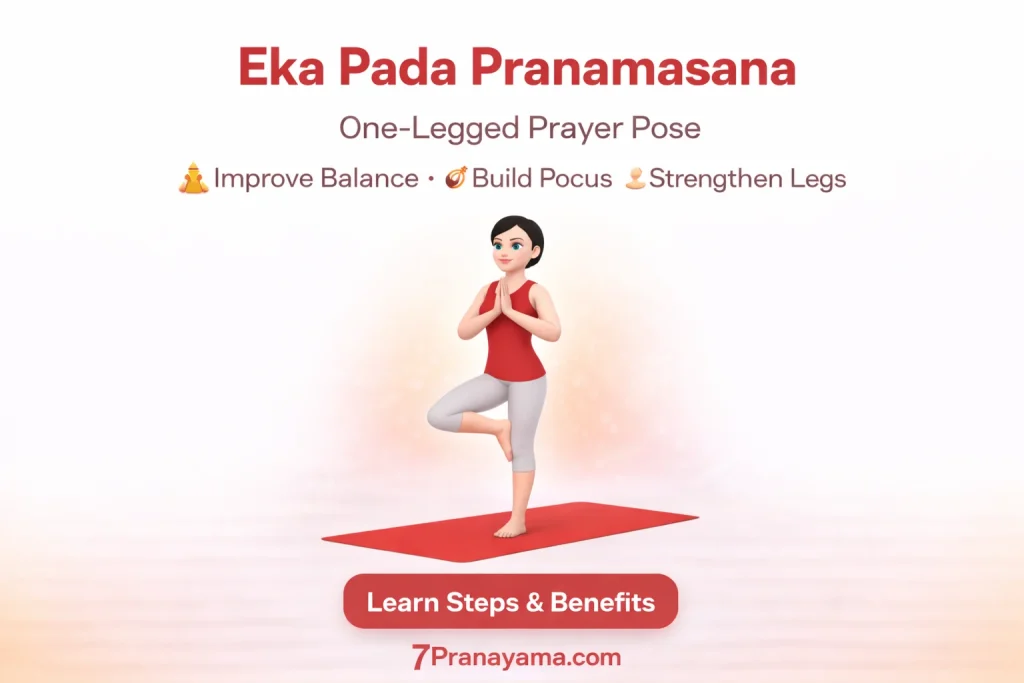
Eka pada pranamasana (one legged prayer pose) is a simple standing intermediate balancing pose that is combination of Pranamasana (prayer pose) and Vrikshasana (tree pose).
This balancing pose is one of the variations of Pranamasana which is the starting pose of Surya Namasakara or sun salutation.
This yoga posture involves balancing on one leg while bringing the hands together in a prayer position at the heart center. It’s a pose that requires focus, stability, and concentration, making it a great way to work on balance and centering oneself. It helps the practitioner to maintain a sense of balance and equilibrium, improves balance, concentration and develops self-confidence.
Eka Pada Pranamasana Meaning
A wonderful breakdown of the name and meaning of Eka Pada Pranamasana – Eka, which translates “one”; Pada, meaning “foot”; Pranama, meaning “prayer”; and Asana, means “pose” or “posture.” The combination of all the words, its pronounced as One-legged prayer pose.
Traditionally, The pose is believed to prepares for Pranayama and Meditation, stimulate the Anahata (heart) chakra, which is associated with love, compassion and empathy, and forgiveness of sins.
Now, let’s learn- how to perform The One-legged prayer pose in a step by step explanation, along with the Benefits and Precaution attached to the pose.
Practice Guide to Perform One-Legged Prayer Pose
The following points are easy and safe practices for Eka Pada Pranamasana Yoga Pose (One-Legged Prayer Pose). So, the practitioners can easily known how to perform One-Legged Prayer Pose, what precautions need to take when practicing this posture, and what benefits it has.
Preparatory Poses
- Vajrasana (Thunderbolt Pose)
- Padmasana (Lotus Pose)
- Siddhasana (Accomplished Pose)
- Sukhasana (Easy Pose)
How to do Eka Pada Pranamasana (One-Legged Prayer Pose)
Starting Position: Begin by standing tall in Tadasana (Mountain Pose) at the front of your yoga mat, with your feet together and arms by your sides.
Shift Weight: Shift your weight onto your left leg while engaging the muscles of the standing leg.
Leg Position: Bend your right knee and bring the sole of your right foot to the inner left thigh. Avoid placing the foot on the knee joint; instead, aim to rest it against the inner thigh or calf of the standing leg. Find a position that’s comfortable for you.
Hands Position: Bring your palms together at the center of your chest in a prayer position (Namaste mudra). Keep your gaze fixed on a point in front of you to help with balance.
Body Posture: Keep your spine tall and shoulders relaxed. Engage your core muscles to help with balance.
Breathing: Breathe deeply and steadily as you hold the posture. Find a rhythm that allows you to maintain your balance and focus.
Hold and Release: Hold the pose for several breaths, gradually increasing the duration as you gain strength and balance. Release by gently lowering the raised foot to the ground and return to Tadasana.
Switch Sides: Repeat the sequence on the other side, balancing on the opposite leg and placing the other foot against the inner thigh or calf.
Adjustment Tips
- Steady Foundation: Begin in Tadasana (Mountain Pose), ensuring a stable foundation and evenly distributing weight on both feet.
- Engage Core: Engage your core muscles to maintain balance and stability.
- Focus on Drishti: Fix your gaze on a point to help with balance and concentration.
- Proper Alignment: Keep the hips level and squared to the front to avoid twisting.
- Use Props: Use props like a block or a wall for support if needed, especially for beginners or those with balance issues.
Follow up Poses
- Tadasana (Mountain Pose)
- Utkatasana (Chair Pose)
- Vrikshasana (Tree Pose)
Precautions & Contraindications
- Always listen to your body, never push beyond your limits, and consult with a qualified yoga instructor if you have any concerns or pre-existing conditions before attempting this or any yoga posture.
- Avoid this asana if you got a recent injury in leg, ankle or foot.
- According to the experts, yoga asana is considered best when yogi practiced early in the morning. Mornings are preferred as the body’s readiness and energy levels to perform the asana. Yet, life doesn’t always align with ideal schedules. Practicing yoga in the evening is absolutely fine, just ensure a few hours have passed after your last meal to allow for better digestion and comfort during the practice.
As with any yoga practice, it’s a good idea to warm up your body before attempting more challenging poses. Consult with a qualified yoga teacher if you’re new to yoga or have any specific concerns or limitations.
Benefits of Eka Pada Pranamasana (One-Legged Prayer Pose)
Physical balance: By focusing on one leg at a time, it enhances physical balance and stability.
Leg strength: It strengthens not only the legs but also the core muscles, promoting overall lower body strength.
Ankle and foot muscle strength: The pose engages and strengthens the muscles in the ankles and feet, which is particularly beneficial for stability and preventing injuries.
Mental balance: The concentration required in maintaining the pose can also help in achieving mental equilibrium.
Nervous system balance: The mindful engagement in this pose can have a calming effect on the nervous system, fostering a sense of tranquility.
Calmness and steadiness: The meditative aspects of this pose, coupled with its physical challenges, can lead to a sense of calmness and steadiness, fostering mental resilience and focus.
Conclusion
Eka Pada Pranamasana yoga pose truly embodies the essence of balance and prayerful focus, as it involves standing on one leg while maintaining a posture reminiscent of prayer. It’s a beautiful way to center oneself both physically and mentally.
FAQ
1. Is Eka Pada Pranamasana good for beginners?
Yes, it’s beginner-friendly and one of the best poses to improve balance.
2. How long should I hold this pose?
Start with 20–30 seconds and increase gradually.
3. Can this pose improve focus?
Yes, balancing poses naturally improve concentration and awareness.
4. Is it the same as Tree Pose?
It’s similar, but Eka Pada Pranamasana focuses more on prayer position and stillness.
5. Can I do this daily?
Yes, daily practice gives the best results.
