
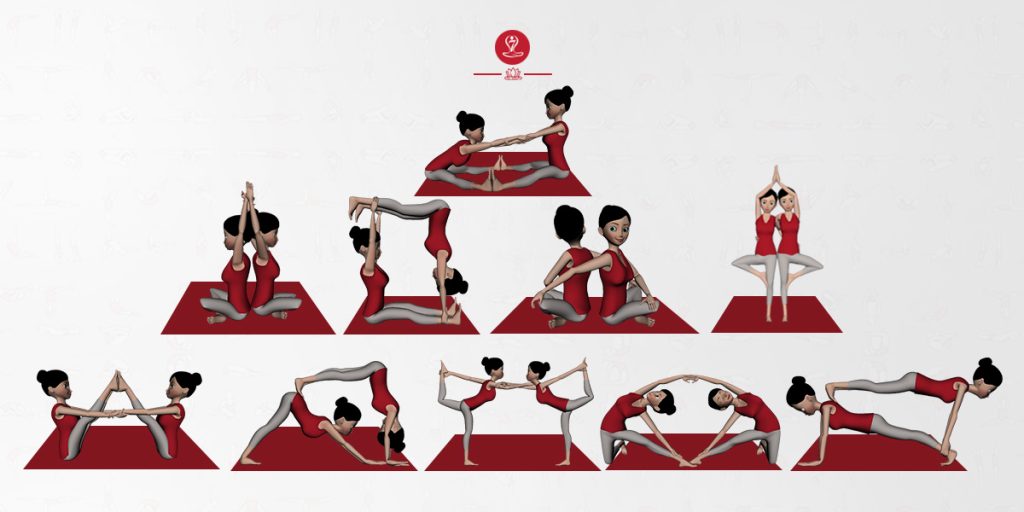
Yoga for two people, also known as partner yoga or couples yoga. When it involves a fun and rewarding way to connect with another person, it is also called acro yoga. It’s a fun and intimate way to deepen your yoga practice together with a friend, family member, or partner.
Table of Contents
- What is Yoga for Two People?
- Benefits of 2-Person Yoga Poses (Partner Yoga)
- Easy Poses of Yoga For Two People
- Partner Tree Pose
- Double Downward Dog
- Gate Pose (Parighasana)
- Squat Partner Pose
- Buddy Boat Pose
- Partner Plank Pose
- Sukhasana Partner Pose
- Partner Forward Fold
- Back-to-Back Twist Pose
- Partner Dancer’s Pose
- Partner Camel Pose
- Partner Warrior III Balance
- Double Child’s Pose
- Partner Seated Cat-Cow
- Partner Supported Fish Pose
- Partner Standing Forward Fold with Shoulder Bind
- Tips for a Safe and Joyful Partner Yoga Practice
- Conclusion
- Frequently Asked Questions (FAQ)
What is Yoga for Two People?
Yoga for couples or partners is a great way to connect with your partner and improve your physical and mental health together.
Practicing yoga with a partner, couple, bestie, friend or sibling can be a fun way to strengthen your relationship on and off the mat, deepen your bond and help you both feel more relaxed and balanced. Practicing yoga together also can deepen your connection, increase trust and communication, and help you both stretch and strengthen your bodies.
So grab your bestie or partner’s hands, along with hopping on your mat, and let’s explore some yoga poses for two people.
Benefits of 2-Person Yoga Poses (Partner Yoga)
Traditionally yoga is an individual’s practice but if you feel like adding some variety to your yoga practice, or want to do something new experience that is not only beneficial, physical as well as mental for you but also for your loved one.
Some of the benefits of yoga for two people (Partner Yoga) are described below that will surely make you try yoga poses with couples.
Builds a physical and emotional connection
To do partner yoga, both of you have to do many poses together. It takes balance and focuses and trusting each other. This is a great way to enhance your connection with your partner, as you learn to ‘let go’ of things, enhance your communication, and trust each other to fully support you in each pose.
Enhanced communication and trust
Partner yoga requires communication and trust between partners as you work together to perform poses. This can improve communication skills and build trust in the relationship.
Increased strength
Partner yoga can require you to use muscles you may not normally use in a traditional yoga practice, which can help to build strength.
yoga doubles support a solo yoga practice with these yoga poses for two people as it brings a whole new level of physical and emotional closeness.
It is important to note that partner yoga should be practiced with caution and under the guidance of a qualified instructor to avoid injury.
Easy Poses of Yoga For Two People
Partner yoga is a practice that involves two people performing yoga poses together, often with one person providing support or assistance to the other. Some potential partner yoga poses include:
Here is some yoga poses that you can practice as a couple:
Partner Tree Pose

Partner Tree Pose is known as Double Tree Pose, a variation of Tree Pose (Vrksasana), which is beginner-friendly. This simple-looking posture creates stability and balance, improves concentration, opens the hips, and is also good for improving balance and overall core strength.
Stand facing your partner, about arm’s length apart. Both partners lift one leg, bending the knee and placing the sole of the foot against the inside of the opposite thigh. Reach for each other’s hands and press your feet into each other for balance. Hold for a few breaths, then switch legs and repeat.
Double Downward Dog

This is an advanced-level partner yoga pose that is more vigorous and energetic than any other pose. Both partners have different positions in this pose, with one partner assuming an L-shape while the other is fully extended in the down-dog pose.
Stand facing your partner with a little space between you. Both partners should come into the downward dog, with one partner placing their hands on the other partner’s hips. Press into your hands and feet, feeling the stretch in your hamstrings and calves. Hold for a few breaths, then switch positions so that both partners have a chance to be the base.
Gate Pose (Parighasana) partner yoga

Gate pose partner yoga is a variation of the traditional gate pose that is a beginner-level yoga pose and also a heart-opening pose that additionally involves strengthens the legs, side-bend and stretch. Enjoy a full-body experience that targets the knee, quadriceps, ankles, inner thighs, hamstrings, and core.
Stand facing your partner, about an arm’s length apart. Take a step back with your left foot and turn it out to the side. Lift your arms to shoulder height and extend them out to the sides. Reach your right arm over your head and place your hand on your partner’s left shoulder. Press your left hand into your left thigh and lengthen your spine. Lean to the right, stretching your right arm up and over your head while your partner presses gently into your shoulder, supporting you. Hold the pose for a few breaths, then switch sides and repeat.
Squarte partner pose
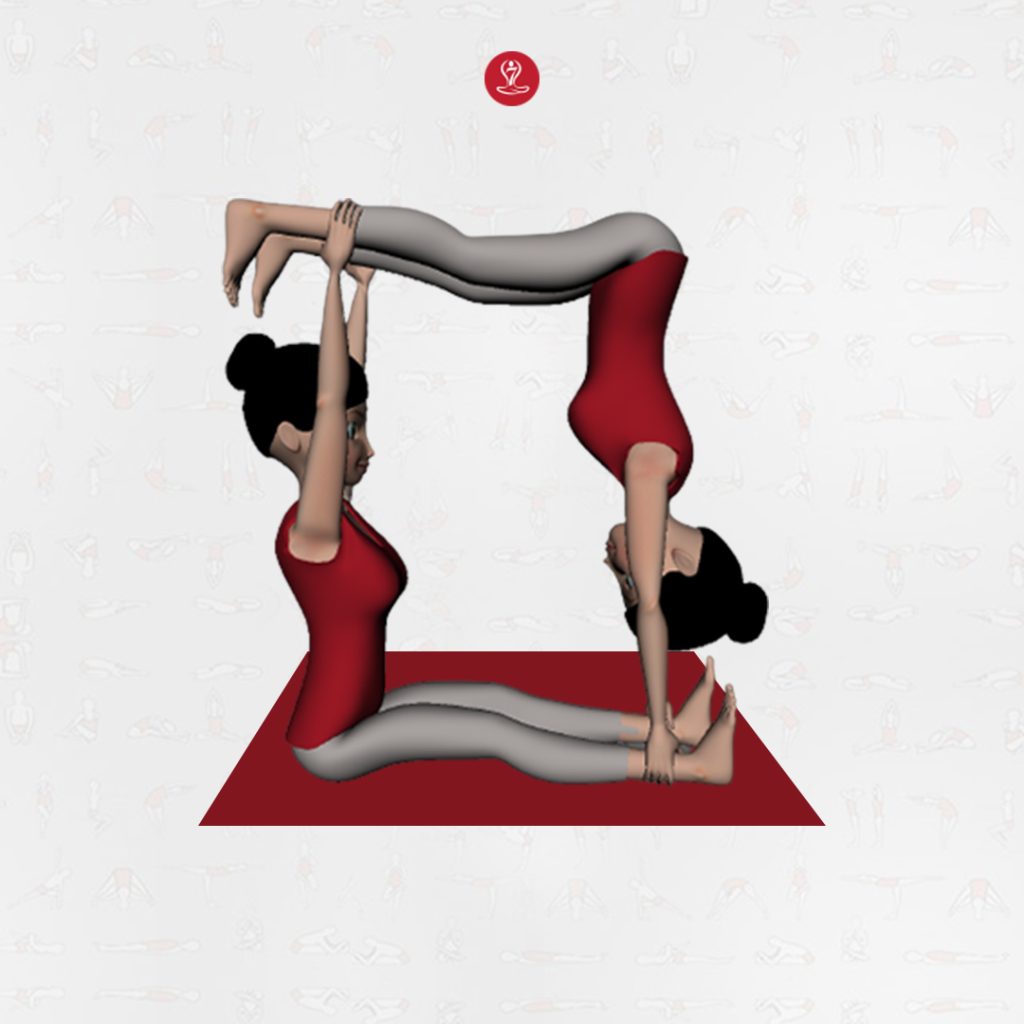
Squatting partner pose is a powerful advanced pose that involves two people working together to deepen the stretch and improve balance. This pose is great for building strength the shoulders, biceps, triceps, core, and hamstrings.
Stand facing your partner, about an arm’s length apart. Take a wide stance and turn your toes out slightly. Lower into a deep squat, with your knees tracking over your toes and your hips sinking down towards the ground. Reach out and take your partner’s hands, palms facing up. Gently press your hands into your partner’s hands, using the resistance to deepen the stretch and improve balance. Hold the pose for a few breaths, then release and come back up to standing.
Buddy Boat Pose

Partner Boat Pose looks like letter A that intensely stretches the core and hamstrings. This is one of the easiest partners poses out there. it requires a lot of flexibility in the legs and the hip flexors aren’t stressed much.
Partners sit facing each other with their knees bent and their feet touching, then hold hands and lift their feet off the ground to come into a boat pose.
Partner Plank pose

Partner Plank Pose also known as Double plank pose. In this pose one partner assumes plank pose on the floor bearing the weight of the other . It can be considered a beginner’s AcroYoga pose that targets on the arms, shoulders, biceps, triceps, and core muscles.
Begin in a plank pose facing your partner. Place your hands on your partner’s shoulders and engage your core to hold the pose together.
Sukhasana Partner pose

Supported Sukhasana is great starting pose for partner yoga practice, two people can easily practice this.
To do this asana, you should sit with your backs in the opposite direction of your couples. After this, while meditating, make contact with your partner by inhaling and exhaling. With this, you will be able to feel the rustle of your partner’s inhalation and exhalation from the back. Do this asana for 3-5 minutes. This yoga connects you with your partner and helps in adopting it better.
Partner forward fold

Partner forward fold is beginner-friendly stretch the hamstrings and lower back with the help of a partner. It’s also known as Intense Dorsal Stretch hat enhances the flexibility of the abdominal as well as targets the hamstrings, calves, and back.
Partners sit facing each other with their legs stretched out in front of them, then reach forward to hold hands and gently pull each other forward into a deeper stretch.
Back-to-back twist pose

In partner yoga, Seated twist pose is a great way to detoxify the body. Partner Seated twist is an easy version of Half Lord of the Fishes pose that opens the chest and back.
Sit facing each other with your legs crossed. Reach your left hand across to your partner’s right knee and your right hand behind you. Twist towards each other and hold the pose for a few breaths before switching sides.
Partner dancer’s pose

Partner Dancer’s Pose is a graceful beginner level posture that you’re able to hold it significantly longer. It nvolves balance and stretch. It’s important to start slowly and work together to find the right balance and alignment.
Stand in front of your partner, about 4 feet away. Keep your feet hip-width apart. Lift your right leg off the ground and extend it behind you, and take hold of your right ankle. Your partner should do the same with his left leg. Extend your left arm forward and grasp your partner’s left arm. Your partner should do the same with his right hand. Once you feel stable, you can begin to bend your left elbow and bring your partner’s arm closer to your body, creating a deep backbend.
Partner Camel Pose
Partner Camel Pose is a beautiful heart-opening backbend that two people can explore together to deepen the stretch and build mutual support. This intermediate-level pose targets the hip flexors, chest, shoulders, and spine, creating an incredible sense of openness and vulnerability — two things that naturally bring partners closer together.
Kneel facing your partner with your knees hip-width apart. Both partners simultaneously reach back and grab their own heels while arching their chests upward toward the sky. Once stable, extend one hand forward to lightly touch or hold your partner’s fingertips for balance and connection. Breathe deeply together, synchronizing your inhales and exhales. Hold for 3–5 breaths, then slowly release and sit back on your heels.
Partner Warrior III Balance
Partner Warrior III is an exhilarating balance pose that challenges you and your partner to work as a single steady unit. This intermediate pose builds strength in the glutes, hamstrings, and core while demanding total trust and focus on one another.
Stand facing each other about two feet apart. Both partners hinge forward at the hips simultaneously, extending one leg straight back behind them while reaching both arms forward to clasp each other’s wrists or forearms. Find a shared gaze point and breathe steadily. The gentle pressure of holding each other creates a beautiful counterbalance that makes this pose feel almost effortless when your timing aligns. Hold for a few breaths, then switch legs together.
Double Child’s Pose
Double Child’s Pose is the most nurturing and restorative pose in partner yoga. It is a gentle resting posture that allows both people to slow down, breathe, and feel deeply held. This beginner-friendly pose is perfect for winding down a session or simply sharing a quiet, grounding moment together.
Both partners come into Child’s Pose side by side, or one partner rests in Child’s Pose while the other kneels behind them and gently drapes their torso over their partner’s back. The weight and warmth of the second partner acts like a gentle weighted blanket, deepening the stretch and creating an intimate sense of safety. Rest here for 5–10 breaths, feeling each other’s rhythm and breath slow and settle.
Partner Seated Cat-Cow
Partner Seated Cat-Cow is a wonderfully fluid warm-up pose that brings awareness to the spine while creating a gentle, rhythmic connection between two people. It is a beginner-friendly movement that feels both playful and deeply soothing, making it a perfect way to open any partner yoga session.
Sit cross-legged facing each other and hold each other’s forearms or wrists. On an inhale, both partners arch their spines, lift their chests forward, and gently draw their shoulder blades together — this is the Cow. On an exhale, both partners round their spines, tuck their chins to their chests, and press their hands into each other for resistance — this is the Cat. Move slowly and intentionally together, letting your breath lead the movement. Repeat for 5–8 rounds, finding a shared pace that feels natural and connected.
Partner Supported Fish Pose
Partner Supported Fish Pose is a deeply restorative heart opener that one partner performs while the other provides gentle, loving support. This beginner to intermediate pose is especially wonderful for releasing tension in the chest, throat, and upper back — areas where many people unconsciously hold stress and emotion.
One partner sits with their legs extended and places a folded blanket or block behind them. They then slowly lower their back over the support, allowing their chest to open and their arms to rest softly by their sides. The second partner kneels beside them and places warm, steady hands on their partner’s shoulders, offering gentle grounding pressure. The supported partner closes their eyes and breathes fully into the chest. Hold for 5–10 breaths, then switch roles.
Partner Standing Forward Fold with Shoulder Bind
This is a deeply satisfying standing stretch that combines a forward fold with an upper body opening, creating a full-body release that feels incredible when practiced with a partner’s support. It is an intermediate pose that targets the hamstrings, lower back, chest, and shoulders all at once.
Stand back to back with your partner, close enough that your shoulder blades lightly touch. Both partners interlace their fingers behind their backs. On an exhale, one partner slowly folds forward at the hips, gently drawing their partner’s arms up and over as the other partner softly arches backward in a supported backbend. Hold for a few breaths, breathing deeply and communicating throughout. Slowly come back to center, then switch roles so both partners enjoy the fold and the backbend.
Tips for a Safe and Joyful Partner Yoga Practice
Before beginning any partner yoga session, it is important to take a few moments to tune in with each other. Check in about how your bodies are feeling, discuss any injuries or areas of sensitivity, and agree on a simple signal — like tapping your partner’s hand or saying “ease up” — that either person can use at any time to slow down or come out of a pose safely.
Always warm up individually before moving into partner poses, especially the more advanced ones. A few minutes of gentle solo stretching, Cat-Cow, or light Sun Salutations will prepare your body and help you both arrive more fully present on the mat.
Communication is the true foundation of partner yoga. Talk to each other throughout the practice — share how a pose feels, ask if your partner needs more or less pressure, and celebrate each other’s small victories. The mat becomes a beautiful space to practice the same listening, patience, and care that make any relationship thrive.
Most importantly, approach the practice with a spirit of playfulness and curiosity rather than perfection. You will wobble, you will laugh, and occasionally you will both topple over — and all of that is part of the magic. Partner yoga is not about performing flawless poses. It is about the connection, the laughter, and the shared experience of growing together, one breath at a time.
Conclusion
Partner yoga can be practiced with a friend, family member, or romantic partner, and can be modified to suit different skill levels and physical abilities. This can be a great way to deepen your yoga practice and connect with another person. It also can be a fun and rewarding way to deepen your connection and improve your health together.
It is important to communicate with your partner throughout the practice and to only go as far as you both feel comfortable.
Frequently Asked Questions (FAQ)
Not at all. One of the beautiful things about partner yoga is that it welcomes all experience levels. A complete beginner can practice comfortably alongside someone with years of yoga experience. Many poses actually work better when one partner is more flexible or stronger, as they can offer support and stability to the other. What matters most is patience, communication, and a willingness to learn together.
Wear comfortable, form-fitting clothing that allows a full range of movement without riding up or slipping. Avoid loose or baggy tops, especially for poses like Double Downward Dog or Partner Plank, where your clothing can get in the way or make it harder for your partner to find a stable grip. Both partners should practice barefoot for the best grip and connection with the mat.
All you truly need is two yoga mats placed side by side, or one large mat if available. As you explore more restorative poses like Partner Supported Fish Pose, a folded blanket or a yoga block can be a lovely addition. Yoga straps can also be helpful for Partner Forward Fold if either person has tighter hamstrings and needs a little extra length to comfortably reach their partner.
Even once a week can create a meaningful difference in how connected, relaxed, and in tune you feel with each other. If you are both new to partner yoga, starting with one or two sessions a week gives your bodies time to adapt and your communication to grow naturally. As you become more comfortable with the poses, you can increase the frequency or simply weave a few partner poses into your existing solo practice.
Absolutely not. Partner yoga is a wonderful practice for anyone who shares a bond of trust and mutual respect — friends, siblings, parents and children, classmates, or workout buddies. The poses are designed to build connection and communication, which benefits every kind of relationship. Many yoga studios offer partner yoga classes specifically for friends or family members, not just couples.
That is completely normal, especially when you are starting out. Hold each pose for as long as it feels comfortable and safe, even if that is only one or two breaths at first. Over time, as your strength, flexibility, and trust in each other grow, you will naturally find it easier to settle into poses and hold them longer. There is no rush — the journey itself is the practice.
Yes, many of the beginner-friendly poses in this guide are safe to explore at home with a little care and the right mindset. Start with the simpler poses like Sukhasana Partner Pose, Partner Tree Pose, and Partner Forward Fold before attempting more advanced ones like Double Downward Dog or Partner Warrior III. Always listen to your bodies, move slowly, and never push into pain. For more advanced acro yoga poses, it is strongly recommended to learn from a qualified instructor before attempting them at home.
Partner yoga can often be adapted beautifully for different bodies and abilities. Many restorative poses, such as Double Child’s Pose, Partner Supported Fish Pose, and Sukhasana Partner Pose, require very little physical exertion and can be deeply beneficial even for those recovering from minor injuries or living with limited mobility. Always consult a healthcare professional before beginning any new movement practice if you have an existing injury or health condition, and let your yoga instructor know so they can offer appropriate modifications.
Differences in height and body size are very common in partner yoga and rarely a barrier to a beautiful practice. Many poses accommodate different body proportions naturally, and a good teacher can always offer modifications. Poses like Partner Tree Pose, Back-to-Back Twist, and Seated Cat-Cow work well for partners of different sizes. For poses that involve one partner bearing the other’s weight, such as Partner Plank Pose, it is wise to consult an instructor who can assess what is safe and suitable for both of you.
Always close your practice with a few minutes of shared stillness. Come into Sukhasana — seated cross-legged — back to back, close your eyes, and simply breathe together. Let the session settle in your bodies and minds before moving on with your day. Some partners like to place a hand over their heart and take three deep breaths together as a closing ritual. However you choose to end, take a moment to thank each other for showing up — because that, in itself, is a beautiful act of love and care.
