
There are many advocates and practitioners who believe that yoga can be an effective alternative workout for muscle building and overall strength development.
Yoga involves various bodyweight-bearing postures and movements that can engage and strengthen different muscle groups. Some styles of yoga, like Power Yoga or Ashtanga, can be particularly challenging and physically demanding, requiring significant muscle engagement.
Different yoga postures can indeed target specific muscles and help develop functional strength when practiced correctly.
Yoga, as a form of exercise, primarily uses your own body weight to improve muscular endurance, flexibility, and overall well-being.
The process of holding yoga poses requires sustained muscle tension, which is a fundamental aspect of muscle-building workouts.
How Does Yoga Promote Muscle Growth?
In weightlifting (lifting the barbells or dumbbells), the incremental increase in weight challenges the muscles, leading to strength and muscle gains over time. Similarly, in yoga, you can apply progressive overload by gradually your practice to stimulate muscle growth and overall improvements.
Start with foundational yoga poses that match your current fitness level and gradually progress to more challenging variations. For example, you can start with basic lunges and progress to Warrior Poses (Virabhadrasana I, II, and III) or start with the Plank Pose and progress to more challenging arm balances like Crow Pose (Bakasana).
Increase the duration you hold each yoga pose. Longer hold increases the time under tension, promoting muscle engagement and growth.
Moreover, One of the unique aspects of yoga is its focus on working multiple muscle groups rather than isolating a single muscle. Yoga poses often involve full-body engagement and multidirectional movements, which contribute to balanced muscle development and functional strength.
Poses of Yoga for Muscle Building
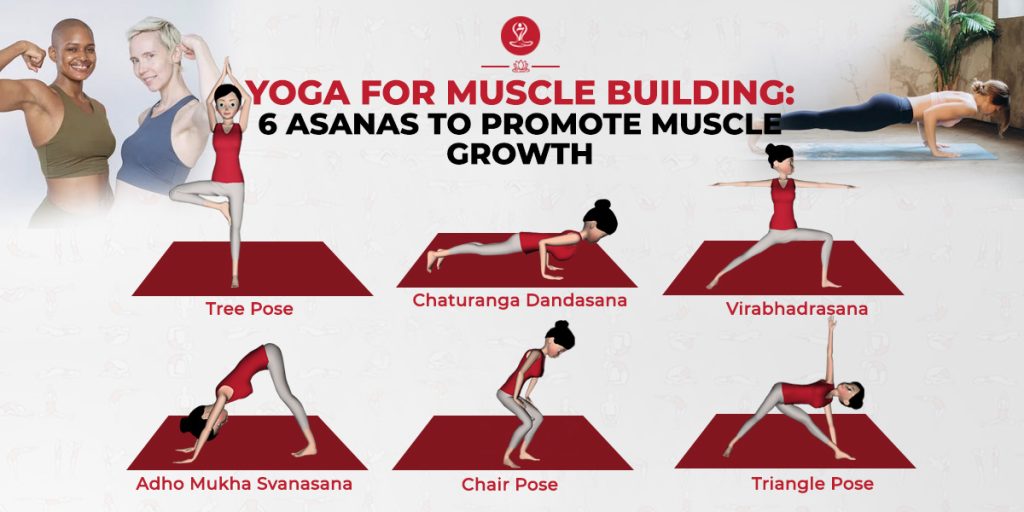
Here are six yoga poses that target different muscle groups and can contribute to muscle building when practiced regularly and with proper alignment:
Tree Pose (Vrksasana)
Tree Pose (Vrikshasana) is an excellent standing balancing pose in yoga that targets the muscles on the side of the leg, specifically the abductors.
By engaging multiple lower body muscles, Tree Pose helps promote strength, stability, and flexibility in the lower extremities.
Steps to perform
- Begin by standing tall in Tadasana (Mountain Pose), with your feet hip-width apart and your arms resting at your sides.
- Shift your weight onto one leg (the standing leg). Ground the foot firmly into the floor, spreading your toes for better stability.
- Place the sole of your foot against the inner calf of the standing leg (below or above the knee joint, but never directly on the knee).
- Bring your hands to Anjali Mudra (Prayer Position) at your heart center, palms pressing together.
- Keep your breath steady and relaxed throughout the pose.
- Stay in Tree Pose for several breaths or as long as you feel comfortable
Tree Pose is a balancing pose that not only engages the lower body muscles but also challenges your concentration and focus.
Downward Facing Dog (Adho Mukha Svanasana)
Adho Mukha Svanasana is a foundational yoga pose that engages and stretches various key muscles in the legs and lower body. It is one of the most widely practiced yoga poses and offers numerous physical and mental benefits.
Steps to perform
- Begin on your hands and knees in a tabletop position.
- Align your wrists directly under your shoulders and your knees under your hips.
- Tuck your toes under and lift your knees off the floor, coming into an inverted V shape.
- Press your hips up and back and lengthen your spine.
- Keep your neck relaxed and allow your head to hang freely between your upper arms.
- Hold Adho Mukha Svanasana for 30 seconds to a minute or as long as you are comfortable.
Triangle Pose (Trikonasana)
Triangle Pose or Trikonasana, is a yoga posture that offers an excellent stretch for various muscle groups in the thighs, hips, and back.
Steps to perform
- Start in a wide-legged stance with your feet about 3 to 4 feet apart, toes pointing forward.
- Turn your right foot out 90 degrees and slightly angle your left foot inwards.
- Extend your arms to the sides, parallel to the floor.
- Start bending down towards your right hip and reach your right hand towards your right foot. Keep your left arm pointing upwards.
- Turn your head upwards to gaze at your left fingers.
- Hold the pose for a few breaths, then come back up to the starting position.
- Repeat on the other side.
Warrior Pose (Virabhadrasana)
Warrior I (Virabhadrasana I) is a powerful yoga pose that primarily focuses on engaging the lower body while also opening the chest and stretching various muscle groups.
Steps to perform
- Stand in Tadasana (Mountain Pose), with feet hip-width apart, and arms alongside your body.
- Step your left foot back (about 3 to 4 feet) and turn it to a 45-degree angle.
- Bend your front knee to a 90-degree angle, making sure it aligns directly above the ankle.
- Inhale as you lift your arms overhead.
- Engage your core muscles for stability.
- Hold the pose for 30 seconds to a minute, breathing deeply.
Chair Pose (Utkatasana)
Chair Pose engages the quadriceps, glutes, and lower back muscles. It is an excellent pose for building strength in the legs and improving overall lower-body stability.
Steps to perform
- Stand tall in Tadasana (Mountain Pose) with your feet together and arms at your sides.
- Inhale as you raise your arms overhead.
- Exhale as you bend your knees as if you are sitting back in an imaginary chair.
- Find a steady point of focus (Drishti) in front of you to help maintain balance and concentration.
- Breathe deeply and hold the pose for 30 seconds to a minute, or as long as you are comfortable.
Plank Pose or Four Limbed Staff Pose (Chaturanga Dandasana)
The Four-Limbed Staff Pose, also known as Chaturanga Dandasana, is a powerful yoga pose that targets the core muscles and develops upper body strength. It is particularly beneficial for building strength in the triceps, among other muscle groups.
Steps to perform
- Begin in Plank Pose (top of a push-up position) with your palms firmly placed on the floor, directly under your shoulders.
- The body should form a straight line from head to heels.
- Your upper arms should form a 90-degree angle with the floor.
- As you exhale, slowly lower your body down, keeping your elbows at a 90-degree angle.
- Hold Chaturanga Dandasana for a few breaths.
Conclusion
Yoga can be a valuable addition to a fitness routine focused on muscle building. While it is often associated with flexibility and relaxation, yoga also offers various poses that target multiple muscle groups and contribute to building strength, stability, and balance.
Some yoga poses, like Plank, Chaturanga Dandasana, Warrior poses, and others, engage and challenge the muscles and can achieve a holistic approach to muscle building and overall physical well-being.
