
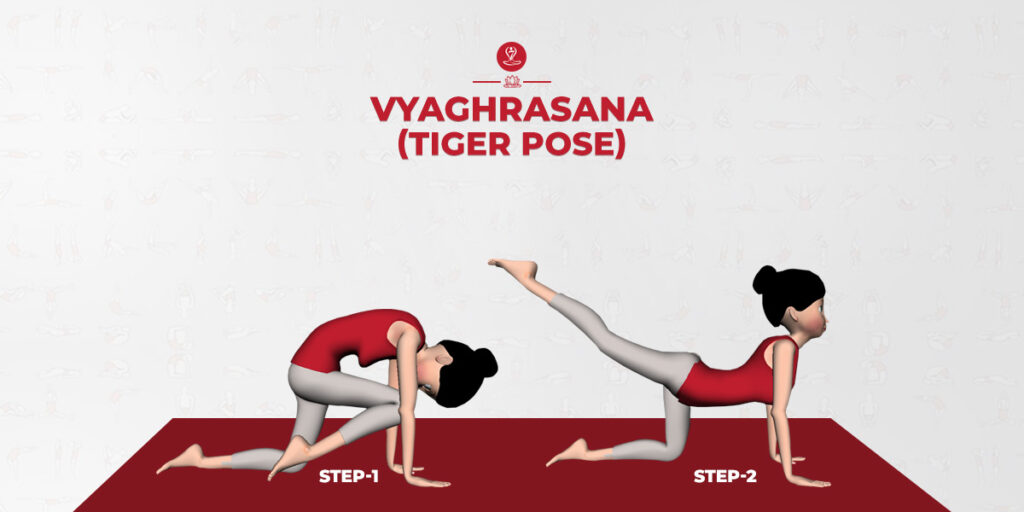
Vyagharasana Yoga Asana is one of the popular yoga postures among the 84 asanas taught by Lord Shiva and is also an important pose of Hatha Yoga.
Quick Summary
Vyaghrasana, widely known as the Tiger Pose in English, is a forward-bending Hatha Yoga posture taught by Lord Shiva. It is especially popular among women for relieving back pain and burning post-delivery fat. Practiced ideally in the early morning on an empty stomach, this simple posture strengthens the spine, stimulates internal organs, improves flexibility, and balances the Svadisthana and Visuddha chakras.
Table of Contents
- Vyaghrasana Meaning
- How to Do Tiger Pose (Vyaghrasana)
- Vyaghrasana Basics
- Preparatory Pose
- Health benefits of Vyaghrasana (Tiger pose)
- Precautions & Contraindications
- Conclusion
- FAQ
Vyaghrasana Meaning
The name comes from the Sanskrit words Vyaghra (Tiger) and Asana (posture), mimicking a tiger stretching after waking up.
In Tiger Pose Yoga, when a tiger wakes from sleep and stretches with its front legs to refresh its body, we follow the same approach in this asana.
However, this yoga has proved to be most beneficial for people doing easy desk jobs who have constant pain in the lower back.
According to the experts, this asana is considered best when a yogi practices early in the morning. Mornings are preferred as the food is digested, and the body has the energy to perform the asana. For some reason, you cannot practice it in the morning, but you can practice this asana in the evening as well. But at least keep a 3-5 hour gap between your practice and a meal.
Tiger Pose is an excellent asana, relatively easy to perform, and can be done by all, from children to the young. This asana must be practiced with the other yoga asanas. Let us look at how to do the Tiger pose as well as different steps to change it up.
Vyaghrasana Basics
| Property | Details |
| Sanskrit Pronunciation | Vyaghrasana (Vyah-grah-asana) |
| Meaning | Vyaghra = Tiger / asana = pose |
| Pose Type | Backbend, kneeling, balancing pose |
| Pose Level | Beginner to Intermediate pose |
| Style of yoga | Hatha Yoga |
| Other Names | Tiger Pose |
| Stretches | Hamstrings, hip flexors, quadriceps, chest, and shoulders |
| Strengthening | Spine, back muscles, core, hips, and uterus |
| Duration | 3 to 5 repetitions per leg (holding for a few seconds each time) |
How to Do Tiger Pose (Vyaghrasana)
- To come to the Tiger Pose, First of all, you need to sit in the Vajrasana Position on the yoga mat.
- Now stand on both your knees and raise both your hands forward to shoulder height.
- After this comes the Cat Pose. Place both palms one to two feet ahead of the knees in front and position the bodyweight on the hands and knees.
- Now look in front and give rest to your body.
- Bend the right leg from the knee, bring its knee under the torso, and keep the toes of the right foot parallel to the left knee, on the floor.
- Now lift your back and lower your head towards the knee so that the nose (or forehead) and the knee touch.
- Straighten your right leg back, then lift it up and inhale while raising your head to look at the ceiling. During this, bend your back down.
- Pause here and hold your breath for a few seconds.
- After this, bring the head back downwards and again bend the right leg and touch the head. In this case, you have to exhale.
- In this way, repeat this process with the right foot three to five times. Then repeat with the left foot.
- Do this at least 5to 7 times per foot.
Preparatory Pose
Health Benefits of Vyaghrasana (Tiger pose)
There are many mental and physical benefits of this asana, including reducing stress, improving focus, opening hips, reducing negative emotions and weight, activating creativity, and releasing emotions. With more of its practices, we can get positive results for many diseases.
- Tiger pose is a fantastic, simple way to stretch our body’s hamstrings, hip flexors, and quadriceps, and also helps prepare the body for deeper stretches. The open hip can help to simplify other yoga.
- When doing this asana regularly, it can be beneficial in strengthening the spine by pulling back muscles as well as loosens up the intervertebral joints, and also removing spinal pressure.
- By regularly doing Vyaghrasana, it keeps your body healthy externally. Apart from this, it can also activate and stimulate your internal organs.
- Tiger Pose prepares the body for advanced levels of deeper hip openers yoga asana, such as the Monkey Pose and Pigeon Pose.
- This yoga practice stretches all the muscles in general and facial muscles in particular, and at the same time enhances the effect of blood. And this way adds beauty to your beauty.
- This asana stimulates the Svadisthana, which promotes creativity. This chakra is associated with wellness, abundance, and pleasure.
- It also activates the Visuddha Chakra, which is associated with knowledge and communication. It also promotes the seeking of truth and wisdom.
- Tiger pose should be done to keep the digestive system running smoothly. If you have stomach-related problems like gas, Acidity Reflux, and stomach pain, etc., then it will be more effective.
- This asana also helps in sexual disorders, tones and invigorates the muscles in this area, and especially strengthens the uterus.
- With regular practice, the extra fat around the hips, thighs, abdomen, and waist is reduced, as well as burns the post-delivery or belly fat.
Precautions & Contraindications
- People with an injury or pain in the neck and lower back should not try to do this asana.
- Women should not do the tiger yoga pose during pregnancy.
- If you have problems with high blood pressure, heart disease, hernia, peptic ulcer, etc., do not do this asana.
- Do not do this asana if you are upset with the slip disc.
- You should practice this asana under the guidance of a certified yoga teacher.
Conclusion
Vyaghrasana is an excellent and challenging yoga choice to systematically test and improve the flexibility of your chest, shoulders, hips, thighs, and back muscles. By incorporating regular breathing, proper focus, and a steady sense of balance, anyone from children to young adults can master this pose to tone the body and enhance joint mobility.
FAQ
The name is derived from the Sanskrit words Vyaghra, meaning “Tiger,” and Asana, meaning “yoga posture.” In English, it is commonly called Tiger Pose.
Experts consider early morning the best time to practice because food is digested and the body has high energy. However, it can be practiced in the evening if you keep a 3-5 hour gap between your meal and the practice.
It strengthens the spine, stretches the hamstrings, hip flexors, and quadriceps, improves digestion, tones the uterus, and helps reduce extra fat around the hips, thighs, abdomen, and waist.
People with injuries or pain in the neck and lower back, pregnant women, individuals dealing with a slipped disc, and those suffering from high blood pressure, heart disease, hernia, or peptic ulcers should avoid this asana.
